Sunday, 2 June 2013

The Unmaking of a Bully


My friend adopted internationally.  Hearing the process that led up to that first meeting is exhausting in and of itself.  The interviews, the waiting, the accumulation of documents and dough, the waiting, the disappointments, the waiting, and then finally the 20 hour flight to the very foreign country.  It's like climbing Mount Everest.  And in the same way, the highest of heights is receiving that little one, yet the steps following are just as arduous, requiring just as much care and attention. 

Attachment.

In international adoption, attachment is huge.  Years become literally devoted to creating secure attachment.  The family tries not to go anywhere or have any guests for months.  The child is worn, cobeded, rocked, held, sung to. Limits are put on who can visit, who can feed, who can hold.  The caregivers become physically and emotionally fastened to the child.  And the child learns that when she has a need, the parent will be there to fill it.  Healthy attachment allows the child to trust, to form healthy relationships, and leads to the capacity to care for others.  Without healthy attachment, normal social, emotional, and psychological development can be stunted.  This opens the door to attachment disorder having negative effects on mood, behaviour and relationships.

Gordon Neufeld: "What makes a bully"

Gordon Neufeld who sees the world through attachment eyes addresses bullying in like fashion.  In an hour long session (seen above) called "What Makes a Bully", Neufeld tries to make sense of the bully from the inside out.  He uses a model that explains bullying in regards to instinct and emotion--a model that covers bullying in the vast variety of arenas it can take place.  He first names four prevailing attempts to understand bullying:

4 Prevailing Explanations
- Power thesis - bullying is from an inherent drive for power
- Learned behaviour thesis - bullying is learned and can be unlearned
- Empathy failure thesis - bullies have not been taught to care
- Entitlement thesis - bullies are spoiled

Finding flaw in all these theories, Neufeld looks at bullying with a different lens, the lens of attachment.  His theory: bullying is Alpha instincts gone awry.  He calls it the "Alpha Askew Thesis".  Put very simply (you'll have to watch the video to get the full picture), inherent in humans is the drive to be cared for (dependence) and to care for others (dominance).  Our caring for others includes an alpha instinct (to take control) coupled with a caring instinct (use that control to care for another) .  Individuals can be wounded in a way that devoids the caring instinct from the alpha instinct leaving a deep seated instinct to dominate those seen as weak..

For Neufeld, it is instinctual.  It is deep.  And it stems from an aberration of a healthy attachment reflex where we should be caring for the weak, not exploiting them.  Building them up, not pushing them down.  Fulfilling needs, not creating them.

As a teacher, I am always looking for insight into this phenomenon, a phenomenon that doesn't make any sense to the core of my being.  Bullying.  It's like a different language.  Most of us have to jump outside ourselves to make any sense of it.  We've been teaching against it like crazy.  Not a kid in BC would be unable to tell you four types of bullying.  They love reciting them.  And even with all the "what would you do" scenarios, pink shirt days, and cyber etiquette lessons, it seems as if we haven't made much of a dent.

So if we, even if only for a moment, can agree with Neufeld's idea, what does that mean for teachers?  What would we need to do? What would we need to change?  According to this theory, how can we unmake the bully?  Here are thoughts in waging the war on two fronts:

Relationship work
Every year we "adopt" a new crowd into our care as teachers.  Could our choices in what we do be guided with the attachment choices of the international adoptor?  I am not recommending strapping on the Ergo Carrier and taking our students for a ride.  But should "attachment activities" be the main endeavour in the first weeks of school?  Could students spend focused time with one teacher?  Could activities of trust and reliance be the forefront?

Alpha Instinct work
Then throughout the year, the activities we choose could evoke a caring component that can couple with the alpha component.  Programs such as Roots of Empathy (bringing a baby into class) , buddy reading, singing at the seniors home, and pen (blog) pals could all be strategically carried out.  We could plan our projects with this in mind: never should there be dominance without helping others.  And we could hit this home over and over and over again.

As always, I'm just spit-balling.  But seeing a framework for understanding bullying that tries to explain it in such far reaching and all encompassing terms leads to self-reflection.  And with a phenomenon that is so pervasive and that impacts so many, thought leaders need to spend time working this out and calling for change.  Either way, the question becomes: does what I do make bullies or unmake them?

Thursday, 23 May 2013

Stages of BYOT from a yellow belt

Recently in a BYOT Twitter chat aptly named #BYOTchat, participants were reflecting about their past BYOT year.  A lot of great highs and lows were shared, but as usual, the conversation got to Bring Your Own Technology basics--when and how do the devices get used in class.  In the midst of tweets about...
- giving students more control
- when to allow students to take devices out
- not forcing device use as its not needed for every lesson
...I realized that I have a certain level of comfortability now that I expect won't always be the same.  On a continuum of teacher versus student control, I make choices that tip the scale somewhat toward teacher control.

From May 16, 2013 BYOTchat
At this point, my students use their devices every LA lesson.  And the device is the forefront and focus of the period.  At the beginning of the class I give a mini-lesson that requires my students to use their device to accomplish a certain outcome. I feel I have to for several reasons:
1) we have an hour and twenty minutes together and I don't feel comfortable giving students that much unstructured time
2) I want to keep reminding my students about new ways of using the device
3) I want my students to make a habit of using their devices for educational purposes

Tim Clark (@BYOTNetwork), the facilitator of the BYOT chat, brought up the idea of stages.  I mentioned that I have often looked at the SAMR model of technology integration to remind me about including redefinition use in the classroom.  I brought this model up as a rookie (who hears of one model, and it becomes gospel), not as an expert who has carefully chosen from amongst many.


I have spent some time thinking about the BYOT journey.  In a previous post I talked about baby steps to BYOT. These are the steps that I took in order to get myself to do BYOT in my classroom.  There is a difference, however, between steps and stages.  Now if I was asked to outline BYOT stages from what I know now as a "yellow belt", here is a starter:

Pre-BYOT : "Put those away, we're learning now!"
Teachers are coming from different places.  Typically they have a lot of technology integrated in their program, but not necessarily classroom device use.  There can be a familiarity with ideas around "going to the lab" and using MS office, making presentations, using application software, going paperless.  Some might dabble in hand-in boxes, or even blogging.  This is a pre-BYOT stage.

The Transfer: "What am I going to do?"
I believe the first stage is the planning around BYOT.  It is the picking brains, reading blogs, joining chats stage. It is what I outlined in my baby steps to BYOT post.  I include this as a stage because I believe those in this stage are "one of us". They are grappling with the ideas, brainstorming solutions to challenges, doing all that the rest of us do but without devices in the students' hands. The Decision (D day) to allow devices in the classroom is done and the day when the devices become Vital Educational tools (VE day) is coming. 

The Handheld Honeymoon: "Guess what we get to do..."
This stage is marked by the fumbling and fascination.  The questions at this stage are: "does everyone have a device?"; "does everyone have internet access?"; "what apps and activities are we going to use?".  Students at this stage, though most know their device well, are trying to figure out what it has to do with education.  The stage is marked by complete teacher control.  Some teachers may slowly dip toes into the pool of device use; others may jump in whole hog.  But everyone is getting wet.

The Trust Tango: "Don't let me catch you playing Angry Birds!"
Here we see a gradual release of teacher control.  Everybody is relatively savvy with the device so the testing begins.  Students are checking out where the lines are.  Teachers are checking out where the lines are.  Here is where trust becomes the big issue.  Do the students trust that the teacher is going to provide activities that inspire and awe?  Or is the class in some kind of glorified lock-down filled with rules and "can't dos"?  Does the teacher trust that the students, on the most part :), will stay on task? 

My assumption about the "final" stage:
The Tool Tipping Point: "Here is the task; go figure out the tools!"
Freedom.  Synergy.  Discovery.  Excitement.  Not every day.  But a culture of it.  The device blends into the background.  It becomes a tool, not unlike the geometry set or the calculator or the pencil for that matter.  And mutual learning leads to even cooler activities.  The mind-blowing kind of stuff.

I am positive there are many other ways of looking at BYOT stages.  What have you found?  What am I missing?

Saturday, 4 May 2013

Taking back the Streets: Creating Positive Online Communities


When I wrote in my last post that students "need to be taught how to take care of each other online just as they would be taught to make positive community decisions offline", I wrote it from my blogging armchair--lemon zinger tea in hand. The reality is: creating a positive community is not an easy thing anywhere.  But as teachers, if we are not creating positive community, we are not maximizing the learning potential in students. Safe interconnectedness leads to thriving.  Dan Siegel would describe it like this: "When children are interconnected, in tune with others, and have the capacity to be reflective, it increases empathy and understanding for the self and others."(from a post on his recent visit here by Pam Becker). Gordon Neufeld describes the opposite of safe interconnectedness, saying: "peer interaction is the primary source of wounding" (see his How to Keep Children Safe in a Wounding World description).   Now with the viral acceptance of social media and the blur of what's public and private, the ideas from these influential thinkers need to be applied to the online world.  Questions about positive online communities need to be asked.

Students are in constant community.  Simply ask a classroom of students who has a Facebook account and the hands start flying up.  Now ask the same class how positive their online interactions are and you will get an eye opener.  Sadly, the difference between the nature of the online interactions of adults versus students is akin to the difference between an AA group and Lord of the Flies.  In fact, the community vibe of the boys in Lord of the Flies by William Golding is just the thing that is happening out there in cyberspace--a self-governing disaster. 

As always, I am speaking in general terms.  Definitely, pockets of positive interaction develop.  From back patting communities of Tumblr and Instagram to the creative sharing on multi-player servers in Minecraft, the interaction is not all fluff or harm.  But I would question the depth and meaningfulness of even these connections.  Isn't it the adults in a child's world who draw him or her into depth?  Think of the people who poured into your life, making you who you are.  As I said in a previous post, students need to be poured into, not left to themselves in a community that has no investment in them.

What are the essentials to creating a positive online community?  If it takes a village to raise a child, the village is going to have to be involved online as well.  Here are some ideas about what that village could look like:

Parents
Do not be far removed from what your child does online?  If privacy is developmental (changing kids' diapers is not a private affair) and respect is earned (think about rules around family car use) then it should be no different online.  Some parents know their children's passwords.  Others follow and friend.  Some allow for privacy but have an open dialogue.  Involvement is the key.  But I suggest that simple involvement is the minimum.  Become part of your child's online world, sharing ideas and thoughts as you would around the dinner table or campfire. 

Connected Adults
Model positive online behaviour.  Make good choices about what to share, what to put out there.  Use your Personal Communication Network as a Personal Learning Network.  Use your online influence to make the world a better place, a more thoughtful place, a more creative place.  Take a true interest in others' ideas.  Forever keep in mind: the little ones are watching.  And when you give them a negative inch. . .they just might take it a negative mile.


Teachers
Offline involvement
Creating a positive online community requires people of maturity, empathy, thoughtfulness and discretion.  This kind of teaching is "better caught than taught".  I feel I imparted this best when I was taking students to the seniors home to sing, or to a nearby creek to pick up garbage, or when I took students to Mexico to work at a hospital.  Roots of Empathy, Random Acts of Kindness, managing the schools recycling--giving back or even just giving.  This, I believe, is where we start. . .far from a screen. 

Online involvement
Here is where I defer to those who have thought deeply about this.  David Truss supports teachers jumping right in.  He says in his post Facing Facebook, "When facing the issue of Facebook, our students are there, and we should be there too".  This is a must-read with many examples of successful online teacher intervention and suggestions for teacher involvement.  It really is a post against denying teachers the opportunity to play a role on Facebook but has wonderful thought out advice from a wealth of experience.  His follow up post Facebook Revisited goes into more detail about friending students.  These thoughts he wrote a year later still suggest that teachers intervene when something is not right.

Sarah Kessler in The Case for Social Media in Schools shares the benefits of using social media as a teaching tool.  To her, it's a tool students already know how to use and she shares six reasons why it should be used in school.  What a great way to lead in making online communities positive by making positive online communities.  She also talks about social media networks that allow teachers to control the environment including Edmodo and Edublogs.  (Two programs that in Canada, I believe parents would have to sign off on.)

Now on to the juggling act.  Of course, along with the ethical (I have to live with myself and if I didn't intervene I couldn't do that very well) responsibility comes the legal (oh great, my district has a policy that I have to follow too) or (what?  This great thing I want to do in my class goes against FIPPA) responsibility. A year ago, News1130 reported in this post that at that time BC as a whole didn't have a social media policy in place.  This is understandable.  I can just imagine how difficult it is for large entities to keep up with the rate of change in this world.  But this also screams that THE OPPORTUNITY IS STILL OURS.  Through our involvement (and even through our own blogging and tweeting) we can have an influence making sure that these policies are a product of thought and collaboration.

It takes a village.  I understand why the block parent thing fizzled in the '80's but I always liked the idea--people looking out for the kids in the community.  Although no one has a sign in their window these days, I think the idea of making the streets a secure place is a good and respectable thing.  There is something honourable, proper, and also risky about taking back the streets.  Fighting to clean things up.  And making it safe.  Wouldn't it be something if we could do this online?

Sunday, 21 April 2013

The 3 P's of Authentic Learning


Tim Clark's post on the Ikea Effect and BYOT got me thinking about students building real things.  The idea behind the Ikea Effect (offered here by Dan Ariely) is that when people work at something, they like it better.  Requiring to add an egg makes instant cake mix sales increase; putting together that bookshelf causes a higher valuation of the bookshelf.

This leads to a discussion about students producing over consuming. As opposed to learning from Math tutorial videos (consuming), students can be making Math tutorial videos (producing). The videos they make will be valued higher than their teacher's.  I have felt the pull from consuming to producing in my own life.  Here is my most recent Facebook update:


When we blog, we create.  When we tweet, we add ideas to the great melting pot of global ideas.  Further, we receive feedback, sometimes near instantly.  We feel part of something.  This feeling of connection and creation has even beat out the draw of social games for me which can be initially addicting but don't have the staying power.  Pursuing a feeling of "I made that" will win in the long run.

So what does it take to open the door to authenticity, to shift from consumption to production in the classroom?

My first attempt at authentic learning
When I moved from student services to grade 7 six years ago, teaching Ancient Civilizations was completely new to me.  My solution was to parse out the curriculum to the students.  They made a handout, a presentation, and a quiz.  Then each student would take a class and teach while I learned and tried to catch errors. 


The buy in was good but the setup was long.  I booked the computer lab for a month to the shagrin of my colleagues.  And there were some funny looks when in October I said I hadn't started Mesopotamia yet.  In the end, though, it paid off.  The curriculum was covered and learning took place.

To go deeper into this idea, though, teachers must ask themselves: what are real things?  Is a PowerPoint on Mesopotamian law truly real to the student.  No.  This is Mr. Robinson's reality, not the students.  In order for something to be genuine, the author has to give a piece of themselves in the creation.

And that is happening right now.  Your students are sharing their pictures on Instagram and Tumblr.  They are sharing their video on Youtube.  They are sharing their words and ideas on Facebook.  They are sharing creations on Minecraft.  There is authentic creation going on without the teacher having to say boo.

So the questions become: how do we bring that authentic creative spirit into the classroom?  And how do we guide the learning into meaningful avenues?

Bringing authentic creation into the classroom and guiding it into authentic learning, I am finding, is a big part of BYOT.  In BYOT, students bring their own electronic creation/networking tool and use it in the context of the outcomes we all feel as necessary for learning to take place.  When I was pondering this, three P's emerged that I would like to share.

Power
Students require inclusion in the decisions around the learning goals of their classroom.  True, there is a set of Prescribed Learning Outcomes.  But students need to be given the why's and allowed to choose the how's.  This is not easy.  I believe the teacher needs to do some soul searching, some questioning, and particularly some listening. Giving over power to the students evokes buy in. And the more power we give, the greater influence we have.
Some questions to ponder:
"Am I stifling the creativity in my class?"
"Are there things I am teaching that don't make sense anymore?"
"Can I give my students more choice and control?"

Permission
Permission and access, really.  When a student comes to school with their own PCN (Personal Creation/Connection Network) through lets say Tumblr or Facebook, can we give them permission to access their network for the purposes of learning, transforming their PCN to a PLN.  Often, a student comes to school and is asked to turn that connection off.  So when they head off to the washroom, out comes the phone.  Imagine if a student used their Facebook account to collaborate on learning something.
Some questions to ponder:
"Are there networks my students are involved in that can extend learning?"
"How do I teach my students to use their networks for meaningful learning?"
"Is there some learning I need to do around utilizing my own PLN?"

Protection
Authentic creation can be dangerous on a number of levels.  Students must be taught about Internet safety.  Students must be guided as to what information to share and what to keep private, knowing that everything is a "screenshot and send" away from public.  Also, students need to learn to be good digital citizens. They need to be taught how to take care of each other online just as they would be taught to make positive community decisions offline.
Some questions to ponder:
"What are the legal requirements I have to abide by as I deal with my students posting/connecting online?"
"What is my level of comfortability around online access: classroom only, school-wide, district wide, sky's the limit?"
"Am I making connections with fellow educators in order to maximize my understanding around students PLNs?"

This is a new area for myself.  But as I continue with my BYOT focus, I am asking the above questions.  Could Bring Your Own Technology be transformed into Bring Your Own Learning Network?

Monday, 15 April 2013

What do students need. . .BETTER ANSWER


Last blog entry, I started with Stats Canada to tease out what we need to be teaching our students.  Today, 2 bombs exploded injuring and killing people in Boston.  Sharing that our kids need some training in sales seems pretty low on the totem pole, right now.  So in light of utter tragedy, I must express that there are things that we need to teach our children that have nothing to do with Math or Language Arts. . .or selling.

Social Responsibility is how we in BC, Canada bring ethics into our curriculum.  And to be quite honest, when the offerings for social responsibility Pro D workshops are pitted against the technology ones, I have often found myself learning about Del.icio.us or Twitter when my colleagues are delving into teaching kids to make the world a better place.  But it seems that more and more, we need all our resources. . .every available influence. . .to wage war against a world with a tendency to take care of "number one".

In BC, our social responsibility strands include: CONTRIBUTING to the classroom and school community, SOLVING problems in peaceful ways, VALUING diversity, DEFENDING human rights, and EXERCISING DEMOCRATIC rights and responsibilities.  In light of the tragedy today, could there be anything more important that instilling values such as these in our students.

But the real question is how is it done.  How do we teach people to be socially responsible.  A quick perusal through the October 2001 BC Social Responsibility Framework and you'll see that the scales are voluntary.  The framework provides opportunities to measure the level of social responsibility through "what would you do" scenarios (be it washing dirty car parts in a nearby salmon inhabited stream or helping someone who was having trouble with her locker.)  This begs the question: if we measure the students and provide feedback, will that cause students to take another step towards altruism, compassion, selflessness, kindness.  I don't think so. 

I believe the work done to formulate the social responsibility performance standards was not wasted.  I think it is helpful to measure and provide feedback.  I don't, however, think that measurement and feedback is enough.  So what takes us from writhing id's to thoughtful super egos?  What causes a once self-oriented child to become a sacrificial mother?  What sends a cut throat businessperson into the heart of Africa to spend the rest of his life serving orphans?  This goes beyond "what if" scenarios and 4 point rating scales.

Mother Theresa said:  "I have found the paradox, that if you love until it hurts, there can be no more hurt, only more love."  What keeps us from loving until it hurts?

I am going to make a statement about humanity here.  It's a general statement, but one that connects the dots between our desire for good and our own self centeredness: we are empty.

People are empty.  And they need filling.  They need a whole lot of filling.    The human spirit needs nurturing.  And we cannot neglect the inner part of ourselves.  As I said, it is war.  And we need the Math teacher and the soccer coach and the dance instructor to take up arms.

My twins were born at 30 weeks.  They spent their first few days in a tray attached to wires.  They spent the week after that in an incubator, separated from their mother and I.  When I would come to NICU, the nurses would ask me to do "kangaroo care".  This meant that I would unbutton my shirt and have one of the twins rest on my chest.  This skin to skin contact, said the nurses, would help to stabilize the child, normalizing temperature, heart rate, respiratory rate, weight gain.  The effects can be seen in cognitive development, reduced stress, motor development and proper growth.  How could I refuse.  So there I would sit for as long as I could to help.

When the filling happened, the growth was made possible.  I believe it is the same way with our students.  Without that, all the teaching in the world wouldn't make a bit of difference.

Wednesday, 10 April 2013

What do students need to learn. . .I mean REALLY


For my evening reading I thought I would peruse Stats Canada to check out what they have for occupations.  Now I am not planning on applying for a job there.  I just thought that as an educator, I should see what kind of market my "product" (my students) would be entering.  I was particularly interested in skills.  Really: what skills must I get across to my students.

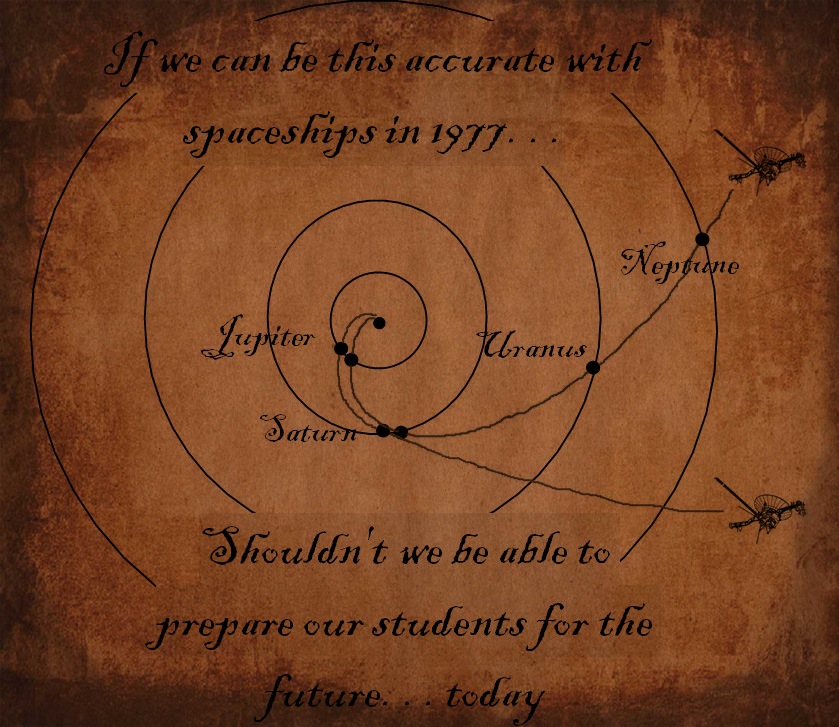
Now I mean hey. . .WE ARE IN THE INFORMATION AGE.  Shouldn't we have a good handle on the breakdown of what people need in terms of skills.  Shouldn't we know with pinpoint accuracy (as when in 1977, the voyager spacecrafts were launched with such precision that they would slingshot around one gas giant to meet the next) what our students need today to meet the challenges of tomorrow. 

Here are some of the stats I came across.  This is a breakdown of what kind of occupations people over 15 were involved in during the 2006 census.

A  Management occupations
9.67%
   B  Business; finance and administration occupations
17.94%
   C  Natural and applied sciences and related occupations
6.57%
   D  Health occupations
5.63%
   E  Occupations in social science; education; government service and religion
8.38%
   F  Occupations in art; culture; recreation and sport
2.97%
   G  Sales and service occupations
23.94%
   H  Trades; transport and equipment operators and related occupations
15.12%
   I  Occupations unique to primary industry
3.84%
   J  Occupations unique to processing; manufacturing and utilities
5.88%
Total experienced labour force 15 years and over
99.99

Stats Canada
http://www12.statcan.gc.ca/census-recensement/2006/dp-pd/prof/92-591/details/Page.cfm?Lang=E&Geo1=PR&Code1=01&Geo2=PR&Code2=01&Data=Count&SearchText=Canada&SearchType=Begins&SearchPR=01&B1=All&GeoLevel=PR&GeoCode=01

How about this.  Here are the top 5 occupations:

OccupationsLabour force (15 years and over)
Counts%
All occupations16,861,180100.0
G211 Retail salespersons and sales clerks729,8404.3
A211 Retail trade managers341,4402.0
G311 Cashiers324,8551.9
G961 Food counter attendants, kitchen helpers and related occupations322,1051.9
H711 Truck drivers304,8901.8


From Stats Canada
http://www12.statcan.gc.ca/census-recensement/2006/dp-pd/fs-fi/index.cfm?LANG=ENG&VIEW=C&format=flash&PRCODE=01&TOPIC_ID=12
   
So was this all a waste of time?  A lot of different skills there, Robinson.  All things won't remain the same.  Who know what the future holds?

I don't think so.

Over 4% of the population will be directly involved in retail sales.  And almost 25% of the population of Canada will be part of sales and service occupations.  This includes occupations like: real estate agents, hairstylists, funeral directors, babysitters, estheticians, butchers and bakers.

Now I am not a statistician, but these figures get me thinking about one thing: sales.  In 2006, 42% of the over 15 workforce was involved in the business and sales categories.  And there will be a continual rise of entrepreneurship adding to the population of sellers.  Won't the ability to sell be huge in the future.  And won't everyone need to sell: sell objects (on Craigslist even :)), sell ideas, sell ourselves to prospective employers.

So as educators and parents, lets teach the very transferable skill of sales: the art of listening to another's needs, the ability to make a convincing presentation, the difference between being persuasive and coercive, the skills to market something, and the idea of a win-win situation. 

Time spent teaching these skills will pay future dividends.

Thirty-five years later and Voyager 1 and Voyager 2 are still active, still sending information back to earth.  There was future thinking behind these programs.  If only our own programs could be so encompassed in what lasts.

Saturday, 6 April 2013

Day 2 BYOT. I've got a problem. . .


It all started famously. . .

For my lesson, I had students go to a bogus web site: allaboutexplorers.com.  I asked them to email me answers to these question:
- Where was Christopher Columbus born?
- When was Christopher Columbus born?
- When did he set sail with the Nina, Pinta and Santa Maria?
- How did it all end with Columbus?

I started getting a few students telling me that Christopher Columbus was born in Australia.  Then later someone asked how Columbus could be born in 1951 but sail in 1942.  Quickly, however, the students realized that something didn't quite make sense.  Then the emails started pouring in:

They got it!  Check your sources...One website ain't enough...Mr. Robinson's a tricky son of a gun.

So here is my problem. . .

Part 2 of the lesson: finish off your brainstorming using the app of your choice.  Then email me a screenshot.  Well the emails started pouring in again.  I've got 27 students and though not all of them emailed me something, several emailed me their work, then changed it and emailed me again. . .


So as I am weeding through all these emails, I was thinking THERE MUST BE A BETTER WAY!!!

This is what I am asking for: I want to "reach" in to each student's device, see what they are doing and how far they got, and be able to evaluate it FOR learning or AS learning.  Instead of it going to me, I'd rather have me go to it. . .but easily.  Is that too much to ask?

So if you have any advice, I'd love to hear it