Showing posts with label innovation. Show all posts

Monday, 4 June 2018

Reflect on your 2018 connections-based learning


It is so important to reflect.

I don't have a great memory. I can enter a room and be clueless as to why I came. And yet I remember stories from decades ago as if they were yesterday. Building tree forts. Ducking behind the fence as my buddy threw lawn darts at me. Getting stitches. Why do I remember those things: because I have reviewed them over and over. I have reflected on them. Sure, as I tell the stories to my own kids, some of the details have evolved. (the darts really did happen, though). But without reflection, the ideas grow cold. With that in mind, here are a few of the more memorable CBL experiences I had this year.

This was a great year of connections-based learning for me and my students. I remember the first week of school, I connected my students with Saul Mwame, a Sustainable Development Goals activist from Tanzania. I really had no definite purpose for this other than connection. Sure I thought he could shed some light on the lack of electricity in Tanzania. But it was the connection that was important.


Months after that first semester class is done, I see the ripple effects of that connection in my last semester's students' tweet supporting Saul's goals.
How can I stop connecting my students when passionate purposeful flames are fanned. I can't.

And what an honour it was for me to connect with champions of gender equality around the world as I prepared to speak at the Qatar Leadership Conference 2017. I couldn't have done it without connections. It speaks to the crucial nature of the CBL #CoOperate focus:


See this post for details on that experience: #CBLchat and #TeachSDGs.

Another highlight for me this year was to watch what mentorship can do as we connect our students with the right guides. Microsoft Vancouver approached me to find some students that would be interested in connecting to utilize the MS Vancouver Garage resources: both tools and personnel. This gave students a chance to really press into the CBL #CoCreate Focus:


The human element is huge in these instances. If I asked students to educate themselves in coding and design through YouTube they would not have gotten as far as they did with a human connection. We went through the CBL #CoDesign focus to not only tease out our direction, but guide our work.


Such great progress was achieved between the time we spent time to #CoConstructGoals to the proof of concept demonstrated at the BC Tech Summit. Here is one students' goals at the beginning of the connection:


And here is a video of the product demonstrated at the BC Tech Summit:


What a difference a connection can make!


The CBL #CollaborationLens is a way to guide your connections. If you have no idea to what I am referring, you have got to check this out: Connections-based Learning.


What has been your memorable connections-based learning this year? I would love to see your tweets, hear your stories, listen to your Voxes (join the: CBL Voxer Community!!) and read your reflection posts!

Thursday, 26 January 2017

How to Tackle Light Poverty


On November 21st, 2016, I wrote a post called Doing Something Beyond Ourselves.  In it, I outlined an idea that I wanted to press into: meaningful making in connections-based learning.  Provoked by a connection, the natural response is to ask "what are we going to do/make about it?"  Admitting my own lack of electronics skill, I went about making connections to facilitate my students to get involved with battling light poverty.  We went through the whole CBL process as we connected with collaborators in New Brunswick and the Dominican Republic: design, network, create, and celebrate.


What follows is what my students created in response to our connection with students in Santo Domingo, Dominican Republic and the Engineering Brightness group with Ian Fogarty in Riverview, New Brunswick.  I am very proud of where the students got to: prototyping, fundraising, light building, connecting with other schools.  It was a pleasure to work with these students.

When a connection is made, the possibilities blow open wide.

I encourage you to look at these student "Artifacts of Learning" posts, see what they have accomplished, hear what they have learned, and comment on their thoughts.

Lantern Housing Design

became

These students prototyped their own light, designing and 3D printing the lantern housing.  They created top and bottom, ready to add the light components.

Gavin's Post  Liam's Post  Owen's Post

Fundraising
became


Janna's Post  Angie's Post  Sabrina's Post

These students connected with other schools to raise money and awareness for light poverty.  Right now schools around our district are getting involved and raising money to help the cause of light poverty.  Other students put on a Photo Booth to raise money.  They created a video to advertise the event.


Social Media Campaign


Electricity Production Design

became


These students developed an innovative technology to use kinetic energy to charge the lights.  These shake-able lights could be carried around by a person or an animal to charge and then used at night.  In these posts is a video that asks for future students to continue working on the idea.

Alhan's Post  Josh's Post  Ben's Post  Zac's Post

CBL Historians


These students created a video to curate the activities and learning that was happening with the teams.

Ella's Post  Clare's Post  Ria's Post

Lantern Production


became


These students were able to re-create the Engineering Brightness New Brunswick students' design and make a fully functioning light.

Kaleb's Post  Olivia's Post  Evan's Post


These students all helped in other capacities to tackle light poverty: creating Powerpoints, participating in Skype chats, supporting other teams, finding other methods of creating lights, and bringing an awareness to light poverty.


Thanks for walking with us as we attempt to tackle light poverty!  Support us in further attempts by visiting our My Class Needs page:


Monday, 26 December 2016

Dare to Dream | #CBL Collaboration Lens


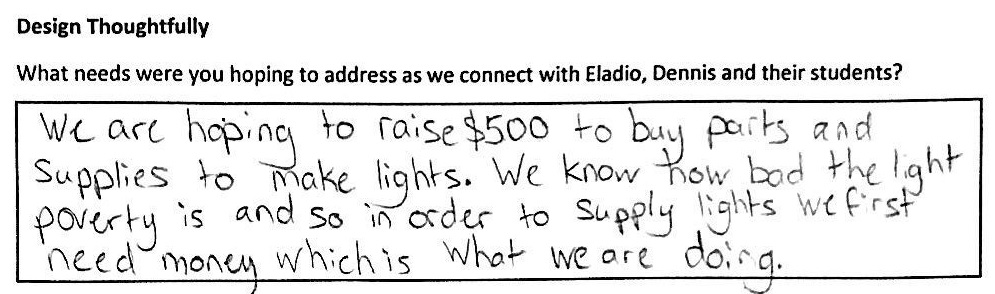
1.3 billion people don't have access to sustainable lighting.  The immediate danger isn't the carcinogenic nature of kerosene lamps: people are dying in fires due to flame based light use at night.  My Science 9 students got to hear firsthand of the conditions in areas dealing with light poverty.  In a Skype chat with Eladio, Dennis and their students from The Community For Learning School in the Dominican Republic, we heard about the conditions in the bateyes.  These workers in the sugar cane fields live with little to no electricity; accessing safe light at night is one of the many struggles with which they deal.


In Doing something beyond ourselves I share my dream of meaningful making with Connections-based Learning. Connections-based learning is an approach to teaching and learning that leverages the connected world.  After making a connection, the most natural response is to ask "how can we help?".  We design the learning experience by first seeking out needs.  I share how we sought the needs in the Dominican Republic bateyes in Empathizing the Local and Global Needs. The students and I then created learning goals together (See: Co-construct Learning Goals) as we sought to meet those needs.  The next step in CBL Design is to develop a response to achieve those goals.  At this stage, students dream what they propose to do and to make.


Dream a CBL Proposal

Time must be given for students to dream up a response to the need and to flesh out what their response could look like.  Through the inspiration of a real need, brainstorming sessions, and group discussions, students develop their plans.  We used OneNote Class Notebook to collaborate and share ideas.  We also Skyped with Ian Fogarty and his students and learned about Engineering Brightness, an association of teachers hoping to address light poverty by STEM based making.  I then ask students to make a polished document or blog post that outlines their proposal.  Finally, students share their proposals to the rest of the class to further refine, get help for ideas, or to combine ideas.  For me, proposal day is just as important as when students share their final products.

Engineering Brightness Student Proposals


"Create a more efficient source of light for countries that have light poverty using electromagnets" - Alhan's Proposal


"Make a solar powered light but also teach them how to make it so they can fix it if they brake it and also they can make even more if they need them so they are self sufficient" - Liam's Proposal

"one of our goals, would be for Kaleb to start creating a model of our light source in his Industry and Design 10 course, to give us an idea of what it would look like. We could get help from outside sources of the school, with the connections that we have made from the Skype calls, or even with a new source." - Olivia's Proposal


"Fundraise enough money to supply Alhan's group to make shakable lights and be able to teach our friends in the Dominican Republic to make lights as well" - Ashiana's Proposal

"We could do a bake sale and possibly pair up with another group and maybe work with Citadel Middle School and their leadership team to raise money at their school. - Clare's Proposal

"Raise awareness about the light poverty in the Dominican, and also raise $1000 dollars towards buying/making lights to send to the Dominican Republic" - Sabrina's Proposal

"Our plan is to make a power point on everything that has happened during this project and what other people are doing. To also try and spread awareness for light poverty." - Brynne's Proposal


"We were thinking about working with solar power, because it’s safer and easier to charge the light, we also thought that it’s really interesting and trying new stuff. We are now connecting with a company called Liter of Light to get some ideas" - Maria's Proposal

The above links are just a few of the proposals students shared out to the rest of the class.  Each student works out loud sharing their proposals to allow for meaningful commenting.  I encourage you to take a look at the proposals and make a meaningful comment.


It has been amazing to watch these students' dreams become a reality.  As they connect, design, build, and campaign, they must work as a team.  Part of the CBL design is to plan to work together.  I will share how we do that in a post: Teamwork makes the dream work.

Thanks for walking with us as we attempt to make a difference in light poverty.

See previous CBL Design Posts:
- Empathize Local and Global Needs
- Co-construct Learning Goals
Consider partnering with us as we fight light poverty in the Dominican Republic

Thursday, 8 December 2016

Empathize Local and Global Needs | #CBL Collaboration Lens


My Science 9 students are well on their way with their Connections-based Learning to help the bateyes of the Dominican Republic with the problem of light poverty.  I shared how this CBL came to be in Doing Something Beyond Ourselves.  At that point, I had a few ideas on where I wanted to take my students, but it was all speculation.

Now the students have been unleashed.  Connections do that.  They catch students right where heads meet hearts. They reveal a compassion that might hide dormant without prompting.  Connections fan the flames of empathy and lead to action.  Learning becomes a necessity, not an assignment.

We had two amazing Skype chats focused on light poverty.  You can find a taste of these chats on these student posts:


The Connections-based learning Collaboration Lens helps educators steward the connection.  It is one thing to make an amazing connection with the community, an expert, an organization or another group of students.  It is quite another to maximize it for learning.


I want to share how we used the CBL Collaboration lens to take us from connection into response.  It starts with the Design focus and specifically Empathizing local and global needs.

Empathize local and global needs

Seconds after our Skype chat was over with Eladio, Dennis and the students from the Dominican Republic, we were talking needs. Now the needs might be a little more obvious when we are talking about the people living as sugar cane workers in the Dominican Republic.  There might be one or two hours of electricity a day.  There might be none.  And if electricity is available, it is during the day.  Light at night is a real issue and affects both learning and safety.  It was hard to hear about people dying in fires as a result of candle and kerosene lamp use at night from Dennis during our Dominican Republic Skype chat.

But empathizing needs looked vastly different for the SSEP CBL my students did.  In that case, our experiments would never get on the Space X rocket if they didn't address a need.  The need gives meaning to the action.  It gives meaning to the making.  The need has to be there. Without it, why bother.

My students went through a whole CBL process as they designed their Engineering Brightness learning experience. The first thing was to reflect on the connection, ponder the needs they discovered, and develop the learning goals they have for themselves.  Here are some student samples:


With students discovering needs through the connection, the next step is to Co-construct Learning Goals.  I will continue to share as this CBL develops.  Look for the next post: Co-construct Learning Goals | #CBL Collaboration Lens.

Consider partnering with us as we fight light poverty in the Dominican Republic.

Monday, 21 November 2016

Doing something beyond ourselves


The last time I made an electronics project was in grade 9.  It was a light tree.  A large metal box would hook up to a stereo receiver and pick up the analogue audio signals.  The box would translate the signals into different frequencies which would light up one of the three different coloured lights hidden underneath light globes.  It's gone now, but I kept it around for decades.

There has been something stuck in my mind for some time: meaningful making in Connections-based Learning.

It is so natural.  When provoked by a connection, the natural question to ask our students is:

Now that we know what we know, and have seen what we have seen, and have met whom we have met, what are are we going to do about it?

But also:

What are we going to MAKE about it?

I found the perfect connection to develop my chops in meaningful making several months ago.

I met John Howe in Denver Colorado at ISTE 2016.  He is a pilot, a Smart Exemplary Educator, and a big proponent in STEM education as a STEM institute director. He was presenting in one of the digital playgrounds in front of a bunch of engaged educators.  During his presentation, he shared this video on Engineering Brightness.


I was floored.  This was it.  If ever there was a meaningful making endeavor, building lights to combat light poverty was it.  I stuck around after and asked John about this Engineering Brightness company.  He was clear to say that Engineering Brightness was "more of an association".  He shared about this association and the grass roots nature of the association between the handful of classes involved drew me in even more.

Addressing light poverty. Printed circuit boards. 3D printing. Soldering.

All this was well beyond my capabilities.  You know my experience with electronics: nothing since grade 9.  Add to that I had no supplies, no Makerspace, no 3D printing experience.  The only thing I could do was what I have been teaching my students all this time: make connections.

Really, to do anything amazing, you have to make connections.

I immediately made a connection with a fellow Canadian who had some experience in Engineering Brightness.
Ian Fogarty is an award winning high school teacher, a past NASA researcher and currently co-director for the SHAD network (to name only a small part of his impressive portfolio).  He lives on the other side of the country but he was quick to try to help me out.  We chatted over Skype and he shared his story and passion.  A few weeks later, I was surprised by a package he sent to me: a light prototype.


Meanwhile, I began a connection of another kind.  I sought funding for materials through My Class Needs and Fuel Your School.  Here is my "fund me" page.


At this point, the funding level is low.  In fact, I am not sure if I will get any funds in this way.  But should a perceived lack of funds stop the process?  Not without pressing deeper into the connections.  I added connections from teachers at my school.  Abraham and Ollie, two of our Industrial Design teachers, were quick to come on board.

Most recently I made a connection Eliadio Jimenez Made and his team in the Dominican Republic.  It began as this simple tweet.


I now have a Skype chat set up with Eladio, Dennis (also in the picture), and some of their students.  They will share some of the conditions of the communities surrounding them with my students and give me the chance to ask: so what are we going to do about it.

The idea here is that I have no idea where this is going to go.  And the much bigger idea is: that is okay.  If we are wanting to ask our students to step out of their comfort zones, share their work in portfolios, make meaningful connections, and do meaningful things, we must be willing to do this as educators ourselves.  Blog posts shouldn't only contain the successful, but the not-yet-successful, and the I-hope-this-works, as well.

I am excited to see where this goes and am enjoying the journey and relationships built on the way.

Tuesday, 22 March 2016

Inspire Creative Connections

 
Students' minds should be blown on a regular basis.

The possibilities of what could be should be expanded for our students as often as possible.  When opening up the doors to connection, I want students to think that anything is possible.  When starting a CBL, the first order of business is to inspire creative connections.  When an educator has ignited that spark within the student, the job gets a lot easier.  In a CBL, that spark is the connection.  What follows are some snapshots of inspirational connections. These can be shared with students and teachers alike as we strive to open the doors to meaningful relationships among students, experts, organizations, the community and around the globe.

Inspiration: Rola Tibshirani's Grade 6 Class


When I was asked to hold a Connections-based Learning workshop, I realized that it was hugely important to not only share about CBL but to give my attendees the experience of CBL.  I quickly tweeted Rola Tibshirani and asked if she would Skype in to my workshop.  It was amazing.  It wasn't just that I saw how the workshop became alive as we connected with another educator on the other side of the country, it was the students on the other side of the country that made the experience amazing.  They were sharing a contagious passion regarding the connections they had made throughout their class time with Rola.  Deeply inspiring.

These students were using their 3D printer to make letters to support the work the educational assistants were doing to help struggling students learn letter writing at the school.  These students were connecting with a local banker to support their entrepreneurial projects. These students were connecting with the UN to follow their own passion projects to help accomplish Global Goals.  If you keep your eyes on Rola's classroom posts and tweets you will see a constant stream of interaction with experts, organizations, and the community around.  It's like they're the NCIS special agents up in MTAC room. They are truly inspirational.


Inspiration: David Billikopf's students in a correctional facility

Connections-based Learning should open doors to opportunities that would not be possible without a connection.  David Billikopf teaches at a correctional facility.  He wants to see his students have real life discussions that matter to them.  Not only does he want his students to connect with others while they learn, but he has the added challenge of maintaining confidentiality and student safety with those within and without the prison.  Through creative connections, he has been able to have his students interact with students around the world giving them meaningful true to life learning experiences.

I stumbled onto his work when I noticed a tweet asking if the students ever got days outside the prison.  Through following that twitter stream I was able to watch as Mr. Billikopf's students interacted with a class from Norway, sharing their experiences as students inside and outside prison, sharing poetry, sharing words of encouragement.  I was able to watch as these students built understanding and acceptance.  They became learning partners, spurring one another on.  It was moving just to see this from afar.  As one commenter wrote on Mr. Billikopf's blog: I would not be at all surprised if someday they make a movie out of your successful and most creative project. Congratulations!


Inspiration: Leigh Cassell's Grade 2 Class


Every time I've shared this story from Leigh Cassell, people have been moved.

It is about a globally connected educator who connected her class up with a class from Sierra Leone.  They built up a relationship exchanging letters and learning about each other.  The experience was eye opening for the students as they shared about their respective cultures and traditions.  The students developed a relationship that year that superseded culture and distance. Their connection with "Communities around the World" had been life-changing.  Tragically, a year later disaster struck.

After hearing the devastating news that the class in Lakka, Sierra Leone with which the children were connecting had experienced traumatic consequences as the result of the Ebola Virus, the students' response was: "What are we going to do to help all of the people who are still alive in Lakka?"  A relationship had been built that they couldn't ignore.  The students created posters showing the children there how to prevent the spread of disease: washing hands and sneezing into arms to stop the spread of germs.  Ms. Cassell's students had to do something.  These were not simply unknown students miles away who experienced calamity, these were students with which they had a bond, a bond that lead to understanding and ultimately, compassion.  Is there anything more important that we can do with the 200 days we spend with our students?

And there are more and more inspiring connections that I'm just bursting to share about.

I wrote this on Leigh's blog.

It causes me to think:
- if you don't connect, you can't help.
And
- if you don't share your story with the masses, we all miss out.

This is connection.  This is relationship. This is making a difference.

Wednesday, 2 December 2015

Meaningful Comments: Who?


In Meaningful Comments: Why?, I looked at why good comments are important and the ways they can propel learning.  In Meaningful Comments: How?, I shared the discussions in my classes on how to make good comments: ask questions, expand on ideas, and share your story.  I was reminded in that post by commenter Bruno Winck that when you disagree with the author let them know by respectfully stating your thoughts.  Of course, this is in the hopes of both of you expanding your understanding.  When that happens, it is important for the author to not take things too personally (and delete objectionary comments) but more, to see this as an opportunity to learn and grow.

In this post I want to focus on who should be commenting on each other's work.  In this connected world, work done by the student shouldn't just be seen by the teacher.

Students commenting on each other's work


Publicly commenting on another's work, as Tom Whitby commented in Meaningful Comments: How?, is a relatively new thing.  Other than in peer editing, some kind of gallery walk activity, or an audience-question-time after a presentation, it just isn't done in our classrooms.  Often student work is for the teacher's eyes only.  But I want to state that there is something meaningful about students commenting on other student's work.  When you have to make a meaningful comment, you have to understand both what the author is saying and how you feel and think about it.  The wheels have to turn.  I think all of us Ed blog readers and writers know the feeling: "This is a great post but I just don't have the energy to intelligently synthesize my thoughts and put them into words.  I'll just hit like."  Commenting requires committing valuable resources.

If your hope is to have a community of learners, then your students should be commenting on each other's work.  They need to learn together in a safe environment that promotes sharing.  They need to be involved in each other's learning.  Furthermore, it brings them to operate at the highest level of Bloom's taxonomy: analyzing, evaluating and even creating (their response).


[Bloom's Taxonomy photo, “New Blooms Pyramid“, by Andrea Hernandez licensed under CC BY-SA 2.0.]

Teachers commenting on student work


I've talked a lot about teacher commenting in this series particularly on how it promotes student learning.  In the comment above, it is the teacher who gets to learn.  Either way, learning comes from the dialogue.  The initial post is a shotgun approach to learning; it is the comments that target in on personalized learning.  I would go as far as to say: if you find yourself having to choose between commenting on student work and grading it, I suggest you comment.  The comment propels learning while the grade puts an end to it.

Principals commenting on student work


In this connected world we live, right from his or her office, a principal can connect and encourage a student.  In fact, they need to get in on the action.  What a way to put one's finger on the pulse of what is going on in the classes but to read and comment on what the students are doing within their classes!

Parents, other teachers . . . really anyone


What an excellent learning conversation going on here...from one student's post.  A parent, two teachers, and several students propelling each other to do and to be better.  Parents having a window into what is going on in the class. Other Math teachers chiming in on the student's learning.  Students encouraging each other along in the material.  This is what being in a community of learners is all about.

You

In the hopes of more genuine comments for my students' work from those outside of the school, I thought that I would end this post with a learning opportunity.  Here is a Flipboard magazine of some of my students' blogs.  Please take a moment to check their digital portfolios out and possibly expend some energy and make a comment.  I know they would love to have some of your input into their learning.