I have been working on the Connection Lens book pretty steady for about a year and a half. Because my time is limited, my writing time takes the place of my blogging time. My books, I feel, have a reflective tone and they do somewhat fill my reflective practitioner niche, but nothing really takes the place of blogging for a powerful reflection experience.
So here I am.
What an amazing time we had on Saturday November 7th, 2020 during the Connection Lens book launch. I was so please with the number of friends, colleagues, CBL faithful, and new folk that joined the event. John Hollingsworth, comedian, entrepreneur, and motivational speaker was the consummate host, keeping the event going smoothly, asking tough questions, keeping us focused. Writer of the book's foreword, Dr. Jennifer Williams beautifully shared her connection to me, CBL, and her Teach Boldly passion. Ziauddin Yousafzai, writer of the book's afterword, told a bit of his story about his work in Swat Valley, making connections for his work promoting girls' education. The Connection Lens articulated his view of how education should be. Theresa Laflèche explained her connection with the book as editor and homeschool parent. The speaker lineup did not disappoint.
Here is a recording of the event:
The launch did what it was supposed to do. Not only did it introduce the book to the world, but the event launched the book to an Amazon #1 Best Seller in Educational Reform. I am pleased about this, not for the acclaim, but that I really think these ideas need to get out there. I am excited for anything that can help spread this work to the masses to better the educational landscape.
Thanks to everyone at the launch, and thanks to you, for your interest in CBL. As I mentioned at the launch, you can really help the work by doing three things:
1) Pick up the book from Amazon
- For a price of a Starbucks coffee you can help support the work of connections-based learning and bring the power of the Connection Lens to your sphere of influence. Visit your country's Amazon site and search for "The Connection Lens" or go directly to the Amazon.com site here: bit.ly/CBLbook2
2) Use the book
- Read the book. Use the material in your work. Start a book club and read it with your colleagues. Put these ideas into practice to develop your own connection lens.
3) Review the book
- 5-Star reviews are a great way to get these ideas noticed. Connections-based learning is a grassroots initiative that is bottom up, not top down. The more positive reviews, the more we can get our message out there: human connection makes a difference.
Here is a taste of the book:
And again, thanks for your support. Together we can make classrooms a place of meaning, motivation, and a chance to make a difference for children everywhere.
I would like to start this year off with asking you what you think connections-based learning is. I have spent many years talking about this approach to teaching. But teaching is not about one person spouting off ideas. It is about the transmission of those ideas and the meaning made within everyone else. For this post, I want to share some resources that can help you make meaning from the idea. My hope, though, is that you share your ideas on the approach as we learn and make meaning together.
The CBL wikipedia article gives an outline of the approach as well as how it differs from other 21st century approaches to teaching. It allows for others to share their thoughts, add their ideas, submit their examples. Like all Wikipedia pages, it is a work in progress that blossoms as others add to it.
Getting our terms straight is an important part of communication. I appreciate Kenneth Muhumuza reminding me of this post regarding just that:
#CBLchat: My team @serveUganda and I would like to introduce connections-based learning @teachCBL in Uganda and start training teachers to embrace it. This kind of learning has potential to solve many challenges especially in the developing world. Join the community!#TeachSDGspic.twitter.com/fGydPZ0GqJ
I am so thankful to have been able to paint a more complete picture of my thoughts on CBL with the Connections-based Learning book. I have tried to make this book accessible to as many as possible. Not only am I able to share examples of CBL in action with this book but in the Kindle version, there are links to Twitter hashtags (like #CBLchat and #CoConstructGoals) to allow the conversation to deepen. This is a great starting place for anyone wondering what connections-based learning is all about.
Connectionsbasedlearning.com is also another place to visit on your CBL journey. It outlines the three focuses of CBL: connect, collaborate, and cultivate. It shares ways to connect. It contains research and resources. It is a great spot to bookmark and refer back to.
And many more resources exist to add to your knowledge of connections based learning:
In the end, CBL is what you make of it and how it plays out in your classes. Join our Voxer chat community here: #CBLchat Voxer Community and share what you think connections-based learning is. Or share your thoughts on Twitter using the #CBLchat hashtag. Find me on Instagram at TeachCBL. Comment below. But please, share your thoughts!
The last time I made an electronics project was in grade 9. It was a light tree. A large metal box would hook up to a stereo receiver and pick up the analogue audio signals. The box would translate the signals into different frequencies which would light up one of the three different coloured lights hidden underneath light globes. It's gone now, but I kept it around for decades.
There has been something stuck in my mind for some time: meaningful making in Connections-based Learning.
It is so natural. When provoked by a connection, the natural question to ask our students is:
Now that we know what we know, and have seen what we have seen, and have met whom we have met, what are are we going to do about it?
But also:
What are we going to MAKE about it?
I found the perfect connection to develop my chops in meaningful making several months ago.
I met John Howe in Denver Colorado at ISTE 2016. He is a pilot, a Smart Exemplary Educator, and a big proponent in STEM education as a STEM institute director. He was presenting in one of the digital playgrounds in front of a bunch of engaged educators. During his presentation, he shared this video on Engineering Brightness.
I was floored. This was it. If ever there was a meaningful making endeavor, building lights to combat light poverty was it. I stuck around after and asked John about this Engineering Brightness company. He was clear to say that Engineering Brightness was "more of an association". He shared about this association and the grass roots nature of the association between the handful of classes involved drew me in even more.
Addressing light poverty. Printed circuit boards. 3D printing. Soldering.
All this was well beyond my capabilities. You know my experience with electronics: nothing since grade 9. Add to that I had no supplies, no Makerspace, no 3D printing experience. The only thing I could do was what I have been teaching my students all this time: make connections.
Really, to do anything amazing, you have to make connections.
I immediately made a connection with a fellow Canadian who had some experience in Engineering Brightness.
@ifoggs Heard about ur involvement w/ @Eng_Bright from @preSTEMhowe @ #ISTE2016 & interested in bringing 2 @rside43 in BC. Wanted to connect
Ian Fogarty is an award winning high school teacher, a past NASA researcher and currently co-director for the SHAD network (to name only a small part of his impressive portfolio). He lives on the other side of the country but he was quick to try to help me out. We chatted over Skype and he shared his story and passion. A few weeks later, I was surprised by a package he sent to me: a light prototype.
Meanwhile, I began a connection of another kind. I sought funding for materials through My Class Needs and Fuel Your School. Here is my "fund me" page.
At this point, the funding level is low. In fact, I am not sure if I will get any funds in this way. But should a perceived lack of funds stop the process? Not without pressing deeper into the connections. I added connections from teachers at my school. Abraham and Ollie, two of our Industrial Design teachers, were quick to come on board.
Most recently I made a connection Eliadio Jimenez Made and his team in the Dominican Republic. It began as this simple tweet.
I now have a Skype chat set up with Eladio, Dennis (also in the picture), and some of their students. They will share some of the conditions of the communities surrounding them with my students and give me the chance to ask: so what are we going to do about it.
The idea here is that I have no idea where this is going to go. And the much bigger idea is: that is okay. If we are wanting to ask our students to step out of their comfort zones, share their work in portfolios, make meaningful connections, and do meaningful things, we must be willing to do this as educators ourselves. Blog posts shouldn't only contain the successful, but the not-yet-successful, and the I-hope-this-works, as well.
I am excited to see where this goes and am enjoying the journey and relationships built on the way.
We all have some intuition about the fact that the 21st-century connected world has opened doors to new ways of looking at teaching and learning. We all feel like there is potential to tap into. We might not know how to do it, but we often catch wind of something amazing going on. We are asked to make our teaching more relevant, more personal. We may not feel like we have the tools to do it, but we feel the pressure with this felt potential.
We also know that this potential goes beyond simply what technology offers. It is the human element that makes the difference. It is not enough that online games are more engaging, that apps are more intuitive, that our devices are more powerful. We recognize that education is about the heart. Therefore, it is not about the games, apps and devices, but more the doors those games, apps, and devices open. What, in the end, do they do for us? And how do they help us get to a place of meaning. Really, in education these days, the question has to be: what matters?
I have been trying to share an approach to teaching that can give us a framework regarding answering that question: forming learning relationships needs to be the foundation of learning. Learning must be based on making human connection. I have called it Connections-based Learning I also recognize that there are many terms out there that have been used to add meaning to the idea of connecting our classrooms.
The first order of business should always be to define the terms. What I would like to do is to look at the terms surrounding connection in education to help us reach some common language. The terms Connected Learning, Connections-based Learning, Global Education, and Connected Education are not synonymous. They each have their focus and I will attempt to give each term a solid spotlight in order to clarify the connected landscape.
Connected Learning is a type of learning based on student personal interest. Connected Learning - an agenda for research and design states that "Connected learning is realized when a young person pursues a personal interest or passion with the support of friends and caring adults, and is in turn able to link this learning and interest to academic achievement, career possibilities, or civic engagement." - (Ito, M. et al., 2013).
It is a perfect marriage of peer involvement, interest pursuing, and academic engagement. The focus of the process is not on a certain structure (Ito, M. at al., 2013, p. 45), but more that students' learning happens in the context of pursuing shared interests and goals.
It has a focus on educational reform which includes addressing and eliminating ethnic achievement gaps. The desire is to "bring together in-school and out-of-school learning and activity." and form deeper bonds between different spheres of learning.
Examples of Connected Learning:
"Examples of learning environments that integrate peer, interest, and academic pursuits including athletics programs that are tied to in-school recognition, certain arts and civic learning programs, and interest-driven academic programs such as math, chess, or robotics competitions. These connected learning environments embody values of equity, social belonging, and participation." - p.8 (Ito, M. et al., 2013)
Connected Education has a focus on online learning activities. The term Connected Education was first used in conjunction with personalized learning in the form of online lessons describing the groundbreaking work of Paul Levinson and Tina Vozick. In the 80's, they created masters degree programs that could be completed online. The term Connected Education continues to be used to describe any kind of learning that uses the internet in some capacity.
Here is a 2008 Connected Education video on digitizing lessons. The early focus on Connected Education was to have video lessons readily and easily available for learning.
In the article What connected education looks like - 28 examples from teachers all over, you can see connected education as:
- utilizing learning networks such as Edmodo
- compiling pictures that students take with their devices around a certain topic
- collaborative projects with other classes
- educators blogging about classroom experiences
- district-wide twitter chats
- creating web-based lessons
- sharing educator resources using online bulletin boards like Padlet Global Education
Global Education has a focus on seeing the world as a whole. Learning about the world, its needs, and what must be done to meet those needs is key. In the province of Alberta, we have the Centre for Global Education. This Edmonton Public Schools organization provides opportunities for students to learn about global issues and "the potential youth have to shape a common future" through online conferences and interactive sessions. You get an understanding of Global Education as the TCGE describes its mission:
"The mission of The Centre for Global Education (TCGE) is to educate 21st Century students for a 21st Century world by providing global learning opportunities, enhanced through technology, informed by sound research and innovative teaching."
In Atlanta, Georgia there is The Consortium for Global Education. Their desire is to provide opportunities for students and teachers to help develop global worldview through school partnerships, student exchanges, and collaborative research.
The Centre for Global Education in Belfast focuses on achieving a "just and equitable world". They remind us that part of Global Education is to influence leaders and policy makers, to support organizations that foster social and economic equality, and "to promote an understanding of the interdependency of people across the world."
Examples of Global Education:
- learning about the social and economic needs of another country
- student trips and exchanges
- raising funds for relief organizations
- campaigning for social and economic equality
- service projects that meet needs in a key area of need
- learning global citizenship and sustainable lifestyles
Connections-based Learning Connections-based Learning is an approach to teaching and learning that leverages the connected world by connecting students with their community, learning from experts, supporting organizations, or partnering with peers.
While Connected Learning uses connection to support students' own interests, Connections-based Learning has connection running through every facet of the process. Connected Learning is a more free flowing process that harnesses a student's everyday experience while Connections-based Learning focuses on connecting students with learning or action partners. Connected Education includes utilizing apps to maximize learning; Connections-based Learning uses apps to promote connection to maximize learning. While Global Education often includes a true connection with others outside the classroom, Connections-based Learning must include a connection. Global Education looks outto find the needs of the world; Connections-based Learning looks around finding connection anywhere--from home and the community all the way to the ends of the earth. For Global Education, learning is focused on the world and its needs; Connections-based Learning could include learning about stem cells, or white water rafting, or Mars.
The infographic below clearly shares the nature of Connections-based Learning. This infographic was created in collaboration with Leigh Cassell (see her amazing resource called the digital Human Library) who had a huge hand in the images, wording and focus of this resource.
Clarity is crucial as educators. And without a common language, we are not truly communicating clearly. As connected educators, let's work together to achieve a common understanding as we seek to make better teaching and learning. Please share your thoughts!
References
"Connected Learning". Wikipedia: The Free Encyclopedia. Wikimedia Foundation, Inc.Mar. 8, 2016. Web. Aug. 31, 2016.
Ito, M.; Gutiérrez, K.; Livingstone, S.; Penuel, B.; Rhodes, J.; Salen, K.; Schor, J.; Sefton-Green, J.; Watkins, S.G. (2013). Connected learning: An agenda for research and design (PDF). Irvine, CA: Digital Media and Learning Research Hub.
You might not know this but the international reality TV vocal talent show "The Voice" has iterations in over 50 countries. That means that one quarter of the countries in the world have their own version of it. In Afghanistan it is called آواز افغانستان , in Turkey it is O Ses Türkiye, in Viet Nam it is called Giọng hát Việt. The concept is hugely popular and beats out other reality shows time and time and time and time again.
What is this preoccupation with the voice? And what is it about a voice that makes us just want to drop down on the couch and listen?
We hear it in schools: give students a voice. But what does that mean? What does that look like? And is it as important as we think?
Let's think about our own experience. How do we feel when we believe we've been heard? How we feel when our opinion mattered? When our words become crucial? When our ideas change the course of an event, an organization, a life?
And how do we feel when our voice isn't heard? When our opinion wasn't really considered? When, despite what we say, nothing seems to make any difference?
Voice matters.
There is something that resonates deep in our core about being heard. It is connected with being known. We see it when a colleague shares "Well my thing is. . ." or "I have been working on. . .". We see it when someone starts to blog. They are so excited to share out their ideas. And the ideas are so good. Time and time again I see first blogs shared out to so many. The voice resonates throughout the world getting retweeted, liked and plus one'd. That new voice is refreshing. Its passion renews our own. Being heard doesn't just matter to the speaker, it matters for all the listeners.
So how do we get that in our classrooms? Here are 5 steps to amplify student voice.
Believe
The first step is to believe that our students' voices are important. That they must be heard. That our job as educators is to make sure that happens. Our beliefs pour out of us, and as I have said about many things educational, the importance of voice is 'better caught than taught'.
This belief plays out in how we teach.
Are we co-constructing learning goals with our students? Do students have a voice in how they are evaluated? Are students empowered to control the direction of the class?
A voice is nothing if it isn't heard. I believe our job as educators is to be the linchpin for student connection. Can we connect our students with experts in a certain field? This is not just to hear from the expert, but reciprocate. Give opportunities for your students to help the expert, through awareness, through testing out something for them, through offering feedback.
Are we giving opportunities for students to connect outside the class and school walls? Are we connecting with other educators ourselves? Are we giving students opportunities for their voices to be heard far and wide?
Students need a platform to share their voice. This is why I am so big on digital portfolios. Is there any other way that students can share their ideas in an educational framework? (this isn't a rhetorical question. I'd love to hear other ways that educators are facilitating a platform to share. Possibly leveraging students own already existing platforms?)
Do our students have a place to share out not only their learning but their thoughts? Do our students consider these platforms as their own? Are we demonstrating voice sharing ourselves?
It isn't enough for students to share out. We as educators need to visit where student voices are spoken, and interact with what they've said. It is not enough to let them know that we came. We have to engage with their ideas, and facilitate others' engagement as well: other students, parents, other teachers, experts.
Do we visit student portfolios regularly? Do we take time to offer meaningful feedback to our students? Do we consider meaningful feedback crucial to learning?
This is where the rubber meets the road. The plumb line on the meaningfulness of student voice to us is whether we are sharing it out or not. Blogging, tweeting, Flipboarding, Google Hangouts: all these platforms can propel student voice.
Do we have ways of sharing out our students' creations, ideas, and opinions? Is sharing out part of the classroom routines? Do the activities we do in the class meet our own standards such that we welcome them shared?
We all know that voices are important. Are our students' voices being heard?
Here is a candid conversation about why not to embrace Connections-based Learning. At the risk of setting back a movement I started only a couple of years ago, employ in my classroom, share about at workshops, and blog about frequently, I really want to take a hard look at some reasons why Connections-based Learning might not be for you or your colleagues.
As I sit here up on the top bunk in my hostel room (enduring the snoring and. . .) joining the 14,000 educators in Denver at the ISTE conference, I think about the amazing possibilities that a #CBL lens would have on teaching and learning. But still, I will carve out my top 5 (but I am sure there are others) reasons not to embrace Connections-based Learning.
#1 you'll have to be open to increasing your network
Connections-based Learning is actually what the name says: it is an approach to teaching and learning that is based on connections. In fact, as I have been delving deeper into what is and is not Connections-based Learning and spending time re-imagining the infographic (and in turn deepening the whole approach) with Leigh Cassell, I have become even more adamant that if it doesn't have to do with connection, relationship, partnering, and interaction, it has no part in the approach.
That being said, educators involved in #CBL will not be able to avoid the networking aspect. Time will need to be taken to pursue connections. Effort will need to be expended to contact partners (through avenues such as Connected Learning Partnerships). These connections will have to be managed and cared for as any relationship would. These connections would be two-way, not a flash in the pan, but more the slow cooking turkey basting variety. And Connections-based Learning will require emotional energy to deal with the exposure to the many views and possibilities that a deeply connected educator will come across.
#2 you'll spend more time creating educational experiences
You'll have to take a look at your curriculum and ask yourself, "how can these learning outcomes be achieved in relationship? What are meaningful activities that provide the experience that will allow my students to come away with this kind of understanding.
When you collaborate on something, it requires planning ahead. You have to interact before you interact. And when other parties are involved in the planning process, there's give and take about the what's, where's, and when's of the process. You are going to have to navigate that.
Moreover, some of your learning outcomes might just not seem to fit with a connected experience. You'll have to figure out what to do with that. Connections-based learning will challenge you in ways you may not want to be challenged.
#3 you'll have to take risks
First there's the tech. Collaborating can include some kind of video conferencing if global connections are pursued or experts are brought in from far away. The technology has to be learned and then executed in real time. And when the tech seems to be failing, you're still on. It's like you are hosting a dinner party and there's not enough food, uncle Larry's going off the deep end, and Sarah threw sand in her cousin's face. Can you smile, dig out some poppers from the deep freeze, put Larry in front of the TV, get Sarah to apologize while setting up a temporary eye wash station, and go without food yourself all without losing your smile?
Then there is opening the door to students interacting with organizations, experts, and partner classes. When my student Mo asked Karishma Bhagani, an NYU student hoping to bring her invention of a $10 water purifier back to needy villages in her home country of Kenya, about her thoughts on the aid western countries offer to the developing ones, I had no idea what to expect. Would she be caught off guard, offended, made to feel uncomfortable? Connections-based Learning will lead you into a pattern of risk taking. How will you deal with that?
#4 you'll have to give up more control
The most effective #CBL's I have participated in have been the ones where students create their own goals around an interaction. Can you give up control to your students and have them own the learning. They might not head in the direction you were hoping. And do you really want your class to have the feel of some kind of campaign headquarters? Are you okay with students heading off in different directions all at once? Can you facilitate over orate, listen over speaking, and give up the idea of covering off your curriculum? #CBL will ask you to do all these things.
#5 you'll risk getting involved
The year is done and summer has come. And still Hailey and her partners are working on Karishma's web page. In fact, I remember the call home letting the parents know that their daughter was interacting with an NYU student on her own. I had to make sure it was okay. But I also remember our shared delight, talking about a young person who has found a passion, who has made a resolve to no longer stand aside and watch things happen.
"One of the most exciting latest discoveries that we have found is evidence for water flowing on the surface of Mars today."
These were the words that Tanya Harrison spoke to my Science 9 class during a Google Hangout. They were recorded here:
This is the second time that I had that this-is-so-amazing-that-my-students-get-to-discover-this feeling welling up inside of me this year. The previous time was when we heard from Charis about the work she was doing with pluripotent stem cells. I outline that CBL in the post Can we teach too cutting edge?
And it happened again here. Connecting with an expert not only taught us about what it is like to be the first to receive a picture from Mars, the difference between the Mars rovers, and the future of space exploration. Our connection gave us up-to-the-minute discoveries, including the discovery of explosive volcanism on Mars that day. You can probably tell that I am still beaming from that experience. It was incredible.
Connections-based Learning experiences bring a genuineness into the classroom. They bolster the relationships without and within the class. Shared experiences like helping end water scarcity or aiding orphans and widows in Ethiopia and promoting reading for pleasure in Uganda create a we're-in-this-together kind of feeling with a class. Attendance is affected positively. Student effort increases. The us (teachers) vs. them (students) position that we can sometimes get into can fall away. Students are retweeting teachers. Teachers are retweeting students. There are high fives. Dogs and cats start living together in harmony.
Okay, well maybe the last thought is going a little too far.
But add to this that these students constructed their own goals for the #CBLchat with help from me. I share about the setup for this #CBL experience in How to Design a Connections-based Learning experience. Student responses to our connection were amazing. Here are just a few of them:
I end this post with a call for others to join me. As we take a much needed summer (or winter for those in the southern hemisphere) break and reflect on our past year and where we want to go next year, would you consider including more out of the class connections: serving the community, supporting organizations, interacting with experts, and partnering with classes both locally and globally. Connecting with experts is just one facet of Connections-based Learning.
Join our growing Voxer community where we share our needs, experiences, trials, triumphs.
Share your connected experiences with the #CBLchat hashtag
Sign up for Connected Learning Partnerships joining classrooms around the world, going live this fall.
Visit our #CBL Google plus community and share a post of your connected experiences
Or make a comment below.
Either way, reach out and join us as we learn about and speak into the happenings around the globe ... and even beyond!
The Google Hangout hasn't even happened yet but it has been amazing to see the learning that has taken place. Taking the time to co-construct learning goals with students has allowed the ownership of the learning to change hands. It has been wonderful to see students take ownership of the connection and use it for their purposes, teasing out what they want from it and how they know they got what they wanted. Here I outline the who, why and how of the learning design in a Connections-based Learning activity.
Designing Learning - Who?
Our class' Connections-based Learning is around the solar system and I have set up a Google Hangout with Tanya Harrison, a planetary scientist who has worked extensively on exploring Mars. From working on the Mars Curiosity Mastcam to working on NASA's Mars Reconnaissance Orbiter Context Camera and the Mars Color Imager at Malin Space Science Systems, she has been contributing greatly to amassing a wealth of information about Mars.
After giving my students a short bio and directing them to her website, I asked students to do their own searching about who Tanya is and what she is all about. I wanted them to follow their own rabbit trails as they first touch on this connection.
What does she blog about? What Youtube videos has she done? How does she describe herself? What are her hobbies? What does she share on social media?
It is important for students to get a feel for the person with whom they will be connecting. It is not just about being able to ask the right questions but more so, to start forming their own connections to the expert. What do they have in common? What is surprising about this person? What do they like about her? What might be places of disagreement?
Designing Learning - Why?
Connections-based Learning is all about the why. My desire is for my students to get out of this interaction not only the most possible, but the most meaningfulness possible: to own the conversation, to get their questions answered, to create their own goals for the interaction. When students have been given a voice about what they will learn, their engagement rises, their attention is strategic, their excitement increases. Eventually I am going to ask them to create a response for their interaction. I want that response to be true to who they are and what they can offer the expert.
Designing Learning - How?
After they began to "know" Tanya (from her own presence online), I asked my students to write learning goals in response to what they know about Tanya.
Here are some of the goals: - "I'd like to learn and have a better understanding of Mars and the Curiosity mission" - "I want to know the difference between the Mars Rover and the Curiosity" - I want to know "how she chose the camera she did" - I would like to "discover what space photography is and to learn about it" - "My goal is to successfully understand the concept of how big everything in outer space is" "Hoping to discover what new technology has been innovated in space photography." "Hoping to discover how Mars rovers work and function" "To have Tanya comment on my blog post."
These are their words, not mine: learn, understand, discover.
I also asked students for a sign that they have achieved their goal. "If I can list 3 differences. . ." "When I can explain it to others" "If I learn something new that fascinates me" "When I can describe how it looks" When "I am able to understand the difference in physical appearance and function and share it on my Edublog" "That there is a comment from Tanya on my Edublog post"
One student said: "I would like to learn what it was like to be in the environment of making everything happen." I asked her to explain further as I knew she was getting at something but it needed clarification. She ended up with wanting to know, "what it was like working on the rover process and describe the environment - and how it made you feel." That is the co-construction piece. I need a chance to have a voice into their goals, to help them extract, refine, clarify, polish.
Once learning goals are co-created, the questions flow easily. They are meaningful and they are not the teacher's. They connect with the students own personal goals. The conversation revolves around the students own curiosity and wonderings.
But connections-based learning is about so much more.
When students are partnering with other students, a different facet of learning is taking place. They move from reception to reciprocation. When my students partnered with Matone de Chiwit, one aspect was assembling ideas on a shared Padlet. We got to see the ideas that the Florida students were working on and add our own. Inspired by this interaction, here is what we did.
So when Leigh Cassell approached me with the lofty goal of creating a list of educators willing to partner with learning endeavors from every country in the world, I knew that this had to be done.
Learners partnering locally and globally can lead to so much.
- empathy for others
- synergetic accomplishments
- comparative research
- positive relationships
- a global worldview
...and so much more.
So with that partnership between Ontario (Leigh, and Nicole Kaufman who joined the quest) and BC (me), came Connected Learning Partnerships.
The concept is so very simple yet so powerful: create a spreadsheet of interested educators across the globe who are willing to partner with others. The only thing we request is that if you are approached with a connections-based learning idea, that you respond back: "Sure, let's do it." or "No thanks."
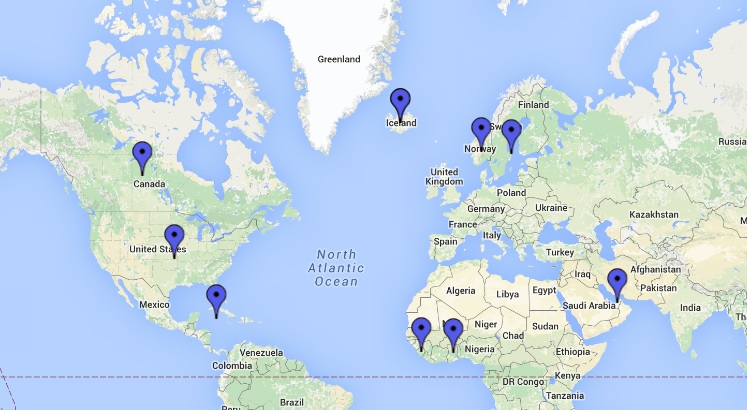
The reception has been amazing. At the time of this post, we have enrolled educators from:
Abu Dhabi, Cayman Islands, Iceland, Ghana, Canada, United States, Norway, Sweden, and Sierra Leone.
From the CLP document:
If you are interested in becoming a member teacher and/or school, you will need at least one staff member to complete the registration form. There is no limit to the number of staff who can register from your school. The more teachers that register, the more opportunities that are created for connected learning partnerships!
Please help us grow the CLP Program by sharing this document with your colleagues around the world. The CLP Contact List will go live beginning September 1st 2016. If you have any further questions, or would like to provide us with some feedback, please feel free to contact us by email.
We would love to have you add your name to the list. We would love to have you share the document with others. We would love to have champions in other continents help us to connect with others around the globe.
I have had the pleasure of being able to watch my students develop a relationship with Karishma Bhagani, an NYU student from Kenya who is the founder of Matone De Chiwit. I shared about her desire to bring her invention of an inexpensive water purifier back to Kenya and to other countries desperately in need of clean water in The Precarious and Powerful. I used that title because I wanted to get across that with connection comes risk. . .but also power. I ended the post with a caveat about relationships: don't go into them blindly, but don't let fear stop you from making them.
As the month has carried on, my students have been working collaboratively to make responses to Karishma and her passionate provocation of helping aid the task of getting clean water to those who don't have access to it. Without further ado, here are some of our purposeful creations to help Karishma's campaign to provide clean water in the areas that most need it.
Commercial to raise awareness about water scarcity and to raise support
"We wanted to create this poster to see if Karishma Bhagani, the person the created the water filtration system, would like to use it for advertising her project. In our poster we included what Karishma made, who it is for, and most importantly what YOU can do to help."
Social Media Campaigns
"Karishma said that she had people working on her Instagram. We thought since Karishma didn’t need someone to make her an Instagram, that we should help promote what Karishma is doing to help."
Work on the Website Creation
"For the Matone De Chiwit, Hailey, Athena and myself are working on a website to spread awareness about Karishma’s campaign. we have been working very hard on the website design so far with Karishma. we have been back and forth for a couple weeks over email."
In Connections-based Learning, its relationships that are the focus. Each facet of the teaching and learning process leverages connection for learning. Whether it is the gathering of information from experts, the formation of meaningful creations that serve a purpose, the sharing out of the process, or the feedback received by others, connection is at the heart. I hope that you can see in these responses how connection is not just weaved in throughout the process but provides the foundation for each action. Purposeful creations stem from connection as we serve, support, partner and question those with whom we connect.
We are so thankful to be able to have the opportunity to partner with Karishma and help fight against global water scarcity. We wish her well as she continues to be a force for positive change in this world!
I recently had the pleasure of sharing Connections-based Learning with my alma mater. It was great walking back into the high school with its quadrangular layout and large spacious halls. I strolled into the library where I would present and the smell took me back to carefree high school days. A buddy and I would spend our free blocks in the theatre. If you can imagine it, we would rarely be on the floor. We would hop from armrest to armrest up, down and across the banks of seats. The biggest challenge was when we hopped over the aisle into the next bank of seats, from armrest to armrest without skipping a beat. Thinking about it now it was recipe for ankle pinnings and neck collarings. For us then, it was something to master, a challenge to overcome, a way to demonstrate expertise.
Every time I have shared Connections-based Learning with educators, I have videoconferenced in an expert. I not only want teachers to learn about connected encounters but to experience them. This time we had the pleasure of bringing in Melissa Lavoie (blog: https://adventuresineduteching.com/). Melissa is an engaging passionate connected educator working as an educational technology special assignment teacher in Timmins, Ontario. She shared a wealth of ideas and experience with us that ranged from Google Apps for Education to inspiring connected experiences. I believe the big take-away for the Centennial High School staff was the three places to find experts that Melissa shared.
When I first heard about the digital Human Library, I knew that I had to share it with as many people as possible. I immediately signed up and put the link on the Connections-based Learning site. When I got to connect with the Founder, Leigh Cassell, I realized how special this endeavor really is. I ended up featuring one of her stories in a post on Inspiring Creative Connections. The digital Human Library has hundreds of experts in nearly any subject area available to be signed out by teachers and classrooms to share their expertise with students. It also has links to hundreds of free multi-media tours. It is a one stop shop for getting connected and leveraging those connections for learning. Using the dHL to connect students with experts allows for an amazing experience, but Melissa shared with us how she took it one step further and used a dHL expert to share with teaching staff.
For a professional day, Melissa brought in an actor to a staff via videoconference. The actor shared with the educators not only his story as an actor but got the educators on their feet (and a bit more comfortable in their skin) doing warm ups and improvisations. Melissa was able to bring to the staff an expertise that she didn't have, a connection that got even the most resistant moving by nature of the authority and experience of an expert. The experience also shared the power of the digital Human Library use itself. The educators walked away having been stretched both physically and mentally.
Making popsicle stick bridges is a great way to teach compressive and tensile strength and the advantages and drawbacks of certain geometric shapes in construction. Students love heating up the hot glue guns and bringing their structural ideas to life. I have done this exact activity with my Science and Tech 11 class. But when I heard about what Melissa did with the activity, I realized how a connection can expand just about any learning experience. Melissa used the VROC connecting platform to find Professor Francesco Tangorra, a civil engineering instructor from Algonquin College in Ottawa, to join the class with which she was working. (Story on p. 24/25 here). Virtual Researchers on Call is a platform that connects STEM professors and professionals with Canadian students for interactive learning. What the engineer did was amazing.
As each student brought their bridge up for testing and applied weights to the structures, Prof. Francesco would be observing via Google Hangout. When the structure failed, the engineering instructor was able to tell the students where and why the structure broke. He would share his wealth of knowledge and experience with the students expanding their ideas about what makes structures strong. The students were completely engaged in the project and came to better understand the artistry and science that goes into making bridges.
The final platform Melissa shared about that connects students with experts is Exploring by the Seat of Your Pants. This platform is focused on Science, Adventure, and Conservation. Melissa shared about an encounter where students were able to experience river rafting through the platform. Amazing! Each experience is stored as a Youtube video in the Exploring By The Seat Of Your Pants Youtube channel. Check out some of the videos as they really give you a perspective on how engrossing this platform is. Give your students the opportunity to go to the bottom of the ocean, a turtle hospital, a bug zoo, Iceland's glaciers or many other locations with this far reaching platform.
One of the four CONNECT facets of Connections-based Learning is Question Experts. In this day and age with innovative platforms such as these, experts in any area are not far from the students. I encourage you to take advantage of this connected world and share ideas from willing experts with your students. Keep me posted about all your incredible connected experiences by sharing in the comments or tweeting out to #CBLchat.