Sunday, 21 April 2013

The 3 P's of Authentic Learning


Tim Clark's post on the Ikea Effect and BYOT got me thinking about students building real things.  The idea behind the Ikea Effect (offered here by Dan Ariely) is that when people work at something, they like it better.  Requiring to add an egg makes instant cake mix sales increase; putting together that bookshelf causes a higher valuation of the bookshelf.

This leads to a discussion about students producing over consuming. As opposed to learning from Math tutorial videos (consuming), students can be making Math tutorial videos (producing). The videos they make will be valued higher than their teacher's.  I have felt the pull from consuming to producing in my own life.  Here is my most recent Facebook update:


When we blog, we create.  When we tweet, we add ideas to the great melting pot of global ideas.  Further, we receive feedback, sometimes near instantly.  We feel part of something.  This feeling of connection and creation has even beat out the draw of social games for me which can be initially addicting but don't have the staying power.  Pursuing a feeling of "I made that" will win in the long run.

So what does it take to open the door to authenticity, to shift from consumption to production in the classroom?

My first attempt at authentic learning
When I moved from student services to grade 7 six years ago, teaching Ancient Civilizations was completely new to me.  My solution was to parse out the curriculum to the students.  They made a handout, a presentation, and a quiz.  Then each student would take a class and teach while I learned and tried to catch errors. 


The buy in was good but the setup was long.  I booked the computer lab for a month to the shagrin of my colleagues.  And there were some funny looks when in October I said I hadn't started Mesopotamia yet.  In the end, though, it paid off.  The curriculum was covered and learning took place.

To go deeper into this idea, though, teachers must ask themselves: what are real things?  Is a PowerPoint on Mesopotamian law truly real to the student.  No.  This is Mr. Robinson's reality, not the students.  In order for something to be genuine, the author has to give a piece of themselves in the creation.

And that is happening right now.  Your students are sharing their pictures on Instagram and Tumblr.  They are sharing their video on Youtube.  They are sharing their words and ideas on Facebook.  They are sharing creations on Minecraft.  There is authentic creation going on without the teacher having to say boo.

So the questions become: how do we bring that authentic creative spirit into the classroom?  And how do we guide the learning into meaningful avenues?

Bringing authentic creation into the classroom and guiding it into authentic learning, I am finding, is a big part of BYOT.  In BYOT, students bring their own electronic creation/networking tool and use it in the context of the outcomes we all feel as necessary for learning to take place.  When I was pondering this, three P's emerged that I would like to share.

Power
Students require inclusion in the decisions around the learning goals of their classroom.  True, there is a set of Prescribed Learning Outcomes.  But students need to be given the why's and allowed to choose the how's.  This is not easy.  I believe the teacher needs to do some soul searching, some questioning, and particularly some listening. Giving over power to the students evokes buy in. And the more power we give, the greater influence we have.
Some questions to ponder:
"Am I stifling the creativity in my class?"
"Are there things I am teaching that don't make sense anymore?"
"Can I give my students more choice and control?"

Permission
Permission and access, really.  When a student comes to school with their own PCN (Personal Creation/Connection Network) through lets say Tumblr or Facebook, can we give them permission to access their network for the purposes of learning, transforming their PCN to a PLN.  Often, a student comes to school and is asked to turn that connection off.  So when they head off to the washroom, out comes the phone.  Imagine if a student used their Facebook account to collaborate on learning something.
Some questions to ponder:
"Are there networks my students are involved in that can extend learning?"
"How do I teach my students to use their networks for meaningful learning?"
"Is there some learning I need to do around utilizing my own PLN?"

Protection
Authentic creation can be dangerous on a number of levels.  Students must be taught about Internet safety.  Students must be guided as to what information to share and what to keep private, knowing that everything is a "screenshot and send" away from public.  Also, students need to learn to be good digital citizens. They need to be taught how to take care of each other online just as they would be taught to make positive community decisions offline.
Some questions to ponder:
"What are the legal requirements I have to abide by as I deal with my students posting/connecting online?"
"What is my level of comfortability around online access: classroom only, school-wide, district wide, sky's the limit?"
"Am I making connections with fellow educators in order to maximize my understanding around students PLNs?"

This is a new area for myself.  But as I continue with my BYOT focus, I am asking the above questions.  Could Bring Your Own Technology be transformed into Bring Your Own Learning Network?

Monday, 15 April 2013

What do students need. . .BETTER ANSWER


Last blog entry, I started with Stats Canada to tease out what we need to be teaching our students.  Today, 2 bombs exploded injuring and killing people in Boston.  Sharing that our kids need some training in sales seems pretty low on the totem pole, right now.  So in light of utter tragedy, I must express that there are things that we need to teach our children that have nothing to do with Math or Language Arts. . .or selling.

Social Responsibility is how we in BC, Canada bring ethics into our curriculum.  And to be quite honest, when the offerings for social responsibility Pro D workshops are pitted against the technology ones, I have often found myself learning about Del.icio.us or Twitter when my colleagues are delving into teaching kids to make the world a better place.  But it seems that more and more, we need all our resources. . .every available influence. . .to wage war against a world with a tendency to take care of "number one".

In BC, our social responsibility strands include: CONTRIBUTING to the classroom and school community, SOLVING problems in peaceful ways, VALUING diversity, DEFENDING human rights, and EXERCISING DEMOCRATIC rights and responsibilities.  In light of the tragedy today, could there be anything more important that instilling values such as these in our students.

But the real question is how is it done.  How do we teach people to be socially responsible.  A quick perusal through the October 2001 BC Social Responsibility Framework and you'll see that the scales are voluntary.  The framework provides opportunities to measure the level of social responsibility through "what would you do" scenarios (be it washing dirty car parts in a nearby salmon inhabited stream or helping someone who was having trouble with her locker.)  This begs the question: if we measure the students and provide feedback, will that cause students to take another step towards altruism, compassion, selflessness, kindness.  I don't think so. 

I believe the work done to formulate the social responsibility performance standards was not wasted.  I think it is helpful to measure and provide feedback.  I don't, however, think that measurement and feedback is enough.  So what takes us from writhing id's to thoughtful super egos?  What causes a once self-oriented child to become a sacrificial mother?  What sends a cut throat businessperson into the heart of Africa to spend the rest of his life serving orphans?  This goes beyond "what if" scenarios and 4 point rating scales.

Mother Theresa said:  "I have found the paradox, that if you love until it hurts, there can be no more hurt, only more love."  What keeps us from loving until it hurts?

I am going to make a statement about humanity here.  It's a general statement, but one that connects the dots between our desire for good and our own self centeredness: we are empty.

People are empty.  And they need filling.  They need a whole lot of filling.    The human spirit needs nurturing.  And we cannot neglect the inner part of ourselves.  As I said, it is war.  And we need the Math teacher and the soccer coach and the dance instructor to take up arms.

My twins were born at 30 weeks.  They spent their first few days in a tray attached to wires.  They spent the week after that in an incubator, separated from their mother and I.  When I would come to NICU, the nurses would ask me to do "kangaroo care".  This meant that I would unbutton my shirt and have one of the twins rest on my chest.  This skin to skin contact, said the nurses, would help to stabilize the child, normalizing temperature, heart rate, respiratory rate, weight gain.  The effects can be seen in cognitive development, reduced stress, motor development and proper growth.  How could I refuse.  So there I would sit for as long as I could to help.

When the filling happened, the growth was made possible.  I believe it is the same way with our students.  Without that, all the teaching in the world wouldn't make a bit of difference.

Wednesday, 10 April 2013

What do students need to learn. . .I mean REALLY


For my evening reading I thought I would peruse Stats Canada to check out what they have for occupations.  Now I am not planning on applying for a job there.  I just thought that as an educator, I should see what kind of market my "product" (my students) would be entering.  I was particularly interested in skills.  Really: what skills must I get across to my students.

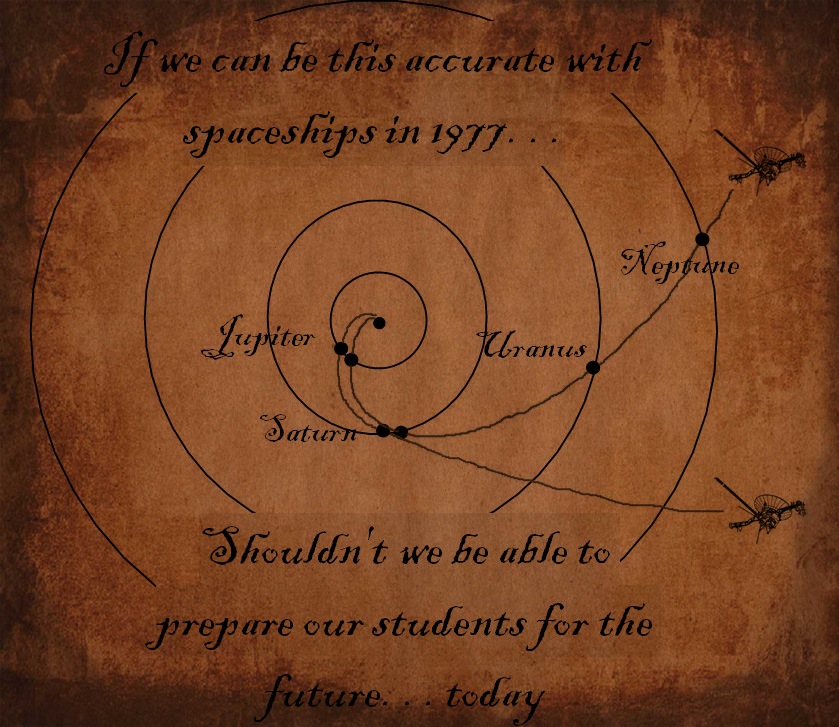
Now I mean hey. . .WE ARE IN THE INFORMATION AGE.  Shouldn't we have a good handle on the breakdown of what people need in terms of skills.  Shouldn't we know with pinpoint accuracy (as when in 1977, the voyager spacecrafts were launched with such precision that they would slingshot around one gas giant to meet the next) what our students need today to meet the challenges of tomorrow. 

Here are some of the stats I came across.  This is a breakdown of what kind of occupations people over 15 were involved in during the 2006 census.

A  Management occupations
9.67%
   B  Business; finance and administration occupations
17.94%
   C  Natural and applied sciences and related occupations
6.57%
   D  Health occupations
5.63%
   E  Occupations in social science; education; government service and religion
8.38%
   F  Occupations in art; culture; recreation and sport
2.97%
   G  Sales and service occupations
23.94%
   H  Trades; transport and equipment operators and related occupations
15.12%
   I  Occupations unique to primary industry
3.84%
   J  Occupations unique to processing; manufacturing and utilities
5.88%
Total experienced labour force 15 years and over
99.99

Stats Canada
http://www12.statcan.gc.ca/census-recensement/2006/dp-pd/prof/92-591/details/Page.cfm?Lang=E&Geo1=PR&Code1=01&Geo2=PR&Code2=01&Data=Count&SearchText=Canada&SearchType=Begins&SearchPR=01&B1=All&GeoLevel=PR&GeoCode=01

How about this.  Here are the top 5 occupations:

OccupationsLabour force (15 years and over)
Counts%
All occupations16,861,180100.0
G211 Retail salespersons and sales clerks729,8404.3
A211 Retail trade managers341,4402.0
G311 Cashiers324,8551.9
G961 Food counter attendants, kitchen helpers and related occupations322,1051.9
H711 Truck drivers304,8901.8


From Stats Canada
http://www12.statcan.gc.ca/census-recensement/2006/dp-pd/fs-fi/index.cfm?LANG=ENG&VIEW=C&format=flash&PRCODE=01&TOPIC_ID=12
   
So was this all a waste of time?  A lot of different skills there, Robinson.  All things won't remain the same.  Who know what the future holds?

I don't think so.

Over 4% of the population will be directly involved in retail sales.  And almost 25% of the population of Canada will be part of sales and service occupations.  This includes occupations like: real estate agents, hairstylists, funeral directors, babysitters, estheticians, butchers and bakers.

Now I am not a statistician, but these figures get me thinking about one thing: sales.  In 2006, 42% of the over 15 workforce was involved in the business and sales categories.  And there will be a continual rise of entrepreneurship adding to the population of sellers.  Won't the ability to sell be huge in the future.  And won't everyone need to sell: sell objects (on Craigslist even :)), sell ideas, sell ourselves to prospective employers.

So as educators and parents, lets teach the very transferable skill of sales: the art of listening to another's needs, the ability to make a convincing presentation, the difference between being persuasive and coercive, the skills to market something, and the idea of a win-win situation. 

Time spent teaching these skills will pay future dividends.

Thirty-five years later and Voyager 1 and Voyager 2 are still active, still sending information back to earth.  There was future thinking behind these programs.  If only our own programs could be so encompassed in what lasts.

Saturday, 6 April 2013

Day 2 BYOT. I've got a problem. . .


It all started famously. . .

For my lesson, I had students go to a bogus web site: allaboutexplorers.com.  I asked them to email me answers to these question:
- Where was Christopher Columbus born?
- When was Christopher Columbus born?
- When did he set sail with the Nina, Pinta and Santa Maria?
- How did it all end with Columbus?

I started getting a few students telling me that Christopher Columbus was born in Australia.  Then later someone asked how Columbus could be born in 1951 but sail in 1942.  Quickly, however, the students realized that something didn't quite make sense.  Then the emails started pouring in:

They got it!  Check your sources...One website ain't enough...Mr. Robinson's a tricky son of a gun.

So here is my problem. . .

Part 2 of the lesson: finish off your brainstorming using the app of your choice.  Then email me a screenshot.  Well the emails started pouring in again.  I've got 27 students and though not all of them emailed me something, several emailed me their work, then changed it and emailed me again. . .


So as I am weeding through all these emails, I was thinking THERE MUST BE A BETTER WAY!!!

This is what I am asking for: I want to "reach" in to each student's device, see what they are doing and how far they got, and be able to evaluate it FOR learning or AS learning.  Instead of it going to me, I'd rather have me go to it. . .but easily.  Is that too much to ask?

So if you have any advice, I'd love to hear it

Saturday, 30 March 2013

Day 1 BYOT


As I started typing in wifi codes and asking students to download any kind of QR code reader they could find, I couldn't help but sense the "are we really allowed to do this?" feeling emanating from my Gr. 7 students. My BYOT shift (I still call it a 'unit' with my students to give me an exit strategy just in case things go awry) started months earlier when I asked my students whether they had some kind of smart device or not. 90% of the hands went up. Being a heavy device user myself (can anyone say Handspring Visor), I felt I needed to try devices in the classroom again. (See my first BYOT post). I handed out permission forms that asked parents to fill out a "use of personal device at school" eform and tried to build some kind of infrastructure. (See Baby steps to BYOT)

But today was day 1. And I wanted it good. I was so happy that at least I had a QRcode to get to my Today's Meet page. The code was a big hit. It saved me from the "what was that URL again?" barrage. It was very necessary as students continually lost wifi. They just snapped a shot of the code and back they were to Today's Meet.

Part 1: Today's Meet

My PLN (okay, basically a bunch of like-minded gurus on the BYOTchat Thursday nights) recommended Today's Meet as my first activity. It was a back channeling website. I had to ask what back channeling was. For the new to BYOT, my understanding is that back channeling is a discussion board that can be accessed from any device. Each comment is streamed to all logged in. From the Today's Meet Website:


I decided to use Today's Meet as it seemed quick and easy to setup and explain.

It is one thing to facilitate a verbal discussion in the classroom. It is quite another to facilitate a chat on Today's Meet. My brain was working overtime as I tried to engage students in appropriate questions and get them beyond their inherent cyber small talk. But Today's Meet revealed what my students do out of sheer impulse. They chat. It seems smaller than small talk and shallower than surface chat. But after all the 'Yo's', 'Hey's', 'Sup's' and 'Mwahahaah's" my students were able to answer questions like:

- What on your device are you an expert at that can help with school?

- In what ways can you imagine using your device to help your learning?

There was even one or two students that took it to the next level asking other students about their app use. I'd love to see more of that in the future. Today's Meet with students requires much more teacher activity that a normal twitter chat. The more the teacher responds, the more useful engagement by the students seems to happen. But it's like responding to 30 journals in real time as the students are writing them. It can make your head spin.

Part 2: Brainstorming

What is a teacher without a project. From Today's Meet, we moved onto working on a project I wanted the students to complete using their devices. This is something they will be working on over the next few weeks.

And who doesn't start a project with some kind of brainstorming or mindmapping? So part 2 was "Now, let's use our devices to get some ideas recorded." And what does a BYOT teacher do when he has several platforms going at once? What the typical teacher would do when a student asks a question that the teacher has no answer to: "go figure it out". My task for them: find an app that can assist you in brainstorming, begin to capture some ideas you have for your project, snap a picture of it and send it to me.

Find app, use app, capture learning, show me.

This is a BYOT mantra in the making.

And I am happy to report that out of my 27 students, I got 4 simple mind maps before the period was done. Better than nothing.

Now before you take exception to my cavalier "you figure it out" style, I did make some honest suggestions as to what app might work. I showed the class a free app I discovered in the Apple App store called Inkflow. It looked like it could do the job. Several of my students gave it a go with some success. The students with IPads had Inspiration that they could use. I even had a student email me a tumbler file. I still haven't been able to open that up on my iphone. (I guess I could try opening it up on my computer :))

So that was my Day 1 with idevices being front and centre. I would recommend doing the same for those starting out. And now Spring Break is coming to a close and I have to gear back up for school and my BYOT "unit". Any thoughts for my Day 2 would be appreciated!


Sunday, 24 March 2013

Baby Steps to BYOT


So you are letting your students use their devices in class. You are moving beyond relegating the smartphone to act simply as a calculator or a timer and letting students really BYO Technology.  It is a big paradigm shift.  One that could change the look, feel, and sense of control of your class.  Before you take the plunge (or as you are taking the plunge), I hope you reflect on the possibilities and pitfalls that may come your way. Here are a few thoughts to ponder as you breach this brave new world.

1) Know why your doing it
BYOT isn't the answer to behaviour problems or lack of motivation in students. It's not the answer to education, either.  In fact, it raises a lot more questions than it answers.  And because of that, you really need to know why you're allowing idevices become a bigger part of your classroom.

Some of the reasons I think that might hold water are:
- a desire to add another effective tool to your students' toolbox
- a passion to encourage students to become full life learners--having a love of learning invade all parts of their life, including device use
- to effectively utilize a tool that students might bring to school yet be told to leave in their lockers
- to experiment with what might seem as the way of the future 

Either way, BYOT is not all pretty.  You'll be inputting wifi passwords, answering endless questions about apps you've never used, and giving students a little more ability to be out of your control. A realistic view of what is coming your way is paramount.  And if you really believe in what you are doing, you'll be able to work through the difficulties. 

2) Build a PLN
It would be ironic for BYOT to be done in isolation. The most dangerous aspect of the smartphone is its connectability. Facebook status updates, texting, tweeting: these are the power, beauty and the danger of the idevice. And your going to ignore all that and go it alone when it comes to teaching kids how to use them for school? It wouldn't make any sense. 

Before I had my first BYOT session with my classroom, I stumbled on a group that "meets" Thursday nights at 6pm PST.  All you need to join in the conversation is knowing this simple secret handshake: the #byotchat hashtag.  Just introduce yourself to the group on twitter. That is all I did.  Immediately, I was embraced as a newbie and accepted as one of the gang. My question of "what should be my first activity" was answered by a veteran and confirmed by several others who were at the time hundreds of kilometres away.  And their suggestions were awesome. 

I am learning that a Personal Learning Network is very important. Before I began blogging and using twitter, my own network was dependant on who happened to be physically around me.  And life at Middle School is so busy, working on an idea becomes buried in a forest of meetings and marking. But with social media, you can follow, share, ask, and hear from a specific group selected from millions. They might teach in the classroom next door. They might teach in another continent. A world of possibilities is opened up. 

3) Have a sitdown with your admin
BYOT opens doors to all sorts of things. And you may find that you become a pioneer of sorts. As a courtesy, you will want to let admin know what is going on in your classroom. You might also find that you need some support, some help setting up the infrastructure.  That is where admin come in. Likely they will be happy to hear that you are addressing the issue of technology in your class. Some of them might even be relieved that they have something to say when the superintendent asks how they are addressing technology in their school.  And whenever you have a "guest" in the school (some "other" who is connecting with the students through something like Skype chats or back channelling) Admin should know. 

Also, you also might find that you need help clarifying the lines: what students are allowed to do and what they aren't. Policy questions always need admin input. 
 
4) Get parent buy in
Hey. They're bank rolling this endeavour.  They should also be kept in the know. I send home a parent permission form for my grade 7 class before the devices come in.  It lets the parents know what I am doing, helps me get parents to fill out the "Privately Owned Devices" eform, and clarifies that this endeavour is not to be used for leverage for birthday and Christmas presents.  And although students are bringing devices to school anyway, it clarifies who is responsible for them. And who is not...me. 

5) Make a plan for the have-notsAlthough you will get a high percentage of students who have devices already, there will be some who either don't have a phone that is "smart" enough or don't have anything at all. You may have a little leverage to get a few devices that can be available for those who have nothing. Many schools are experimenting with Ipads.  See if you can book a few of those.  And make sure you have an extra for someone who just can't get theirs to work. 

If you can't get some extra devices, make a plan to share. Build into your lessons a pair/share component to keep all engaged. Though devices are very personal, the students are used to staring at someone else's screen in the hallway so this will not be new.  A little thought ahead of time will save some headaches later on. 

6) Plan how you connect
On a very pragmatic level, book into your lessons some time to get students on the network. Recently I was on a trip to Disneyland with some teenagers and the constant talk was wifi.  They were desperate for it, checking every place they went to get their wifi fix. In my neck of the woods, most teens don't have a data plan. They'll need a connection to:
- discover new ideas
- share how these ideas jive with themselves. and...
- show their learning so far to you

Learning is all about allowing students to discover, share, and show.  Getting students connected up takes this into the electronic realm.  So make sure you have the network passwords ready and possibly someone to help enter them into your students devices.  But make sure the whole first lesson isn't taken up with getting students on.  What is the fun in that?
 
So here are six thoughts as you take your baby steps into the BYOT world.  And don't be ashamed that you are going slowly and reflecting all the while.  The baby analogy works very well as babies embrace the new with wonder and appreciation.  They soak up experiences without the baggage of the jaded veteran.  And the learning just naturally comes.
 

Thursday, 7 March 2013

Responding to the "Shift to the Future"


I have a grade 7 class that I am trying to move from a "leave your tech in your locker" class to a BYOT class. I had planned that after Spring Break, my BYOT unit would begin.  (I understand that BYOT is a paradigm shift, not a "unit", but hey...I have to start somewhere). I was perplexed because speeches were over and I had a couple weeks unplanned between units.  But as I am getting closer to the time where students are going to pull the world from their pocket and be free to bring it into my class, I have been thankful for class time to set up the infrastructure.  Last class, I spent looking at the school code of conduct about use of technology and then discussing Brian Kuhn's recent Shift to the Future article on BYOT

For my class discussion, each group looked at a different part of the article, summarized what was said and then told what they learned from it.  As each group made a mini presentation I was struck by how my students "get it" when it comes to talking about their devices and the possibilities and problems inherent in using them in class.

One group mentioned that they felt our wired computers can be slow to access the web in the lab which begged the question: how will the wireless network hold up with 27 more devices connected during class time?  We didn't know. 

Another group agreed that it would be possible for everyone to not have a device and still use them effectively. That won't be an issue for us. 

For my group this year, 23 out of the 27 students have planned on using Apple devices (mostly IPod Touches, some IPhones, and a few IPads). We also have  a couple Samsung devices, 1 laptop coming and 1 Surface. Before I planned to do this unit, I had checked with the students what they already owned and was surprised with the kind of access students had.  It was even more than last year's high percentage of students. 

The discussion also got onto distractions.  I tried to explain to the students my role as facilitator: that I wanted to help them through the distractions, not simply punish them because they got distracted.  They seemed well aware that they could be distracted and they needed help. The biggest distraction mentioned was gaming. The students felt they could easily switch to a game when work needed to be done.  Surprisingly, though, another big idea in our discussion was notifications.  My students felt like these could definitely pull them away from work.  That hadn't really occurred to me but when you think about it, that is what a notification is suppose to do.  "Stop what you are doing and deal with me", says the little "1" beside an app.  That is something that definitely needs more thought.  

Some of the other distractions mentioned were: browsing un-educational YouTube videos, texting friends, and updating Facebook statuses. 

Whenever this topic comes up, it causes me to ask these kinds of questions:

- how much more engaging is a BYOT distraction than a regular class distraction (I would love to see research done on this as I think we assume an answer without really checking into it)

- can I teach my students to manage their distractions as we adults might do: e.g. quickly answering an email or text then getting back to work, jotting down an unrelated idea on a todo list, checking the calendar to see what's coming next. 

- how can I change my practice as a teacher to harness the internal motivation that keeps a kid practicing an "olley" for hours just to get it right or causes someone to lose themselves building structures in Minecraft (or another to spend from 3am to 5am commenting on someone's blog posting :))

This blog post was a great catalyst for BYOT discussions and I felt it was a great way to bring the students into the conversation. 

I agree with Brian that focus group work is crucial. I believe it is happening right now in classes around the world and the big work needs to be in sharing what we are learning. I think it is great that we have twitter and Web 2.0 to make this discussion possible.