Monday, 13 June 2016

How to design a Connections-based Learning experience

The Google Hangout hasn't even happened yet but it has been amazing to see the learning that has taken place. Taking the time to co-construct learning goals with students has allowed the ownership of the learning to change hands.  It has been wonderful to see students take ownership of the connection and use it for their purposes, teasing out what they want from it and how they know they got what they wanted.  Here I outline the who, why and how of the learning design in a Connections-based Learning activity.

Designing Learning - Who?

Our class' Connections-based Learning is around the solar system and I have set up a Google Hangout with Tanya Harrison, a planetary scientist who has worked extensively on exploring Mars.  From working on the Mars Curiosity Mastcam to working on NASA's Mars Reconnaissance Orbiter Context Camera and the Mars Color Imager at Malin Space Science Systems, she has been contributing greatly to amassing a wealth of information about Mars.


After giving my students a short bio and directing them to her website, I asked students to do their own searching about who Tanya is and what she is all about. I wanted them to follow their own rabbit trails as they first touch on this connection.

What does she blog about?
What Youtube videos has she done?
How does she describe herself?
What are her hobbies?
What does she share on social media?

It is important for students to get a feel for the person with whom they will be connecting.  It is not just about being able to ask the right questions but more so, to start forming their own connections to the expert.  What do they have in common? What is surprising about this person?  What do they like about her?  What might be places of disagreement?

Designing Learning - Why?

Connections-based Learning is all about the why.  My desire is for my students to get out of this interaction not only the most possible, but the most meaningfulness possible: to own the conversation, to get their questions answered, to create their own goals for the interaction.  When students have been given a voice about what they will learn, their engagement rises, their attention is strategic, their excitement increases.  Eventually I am going to ask them to create a response for their interaction.  I want that response to be true to who they are and what they can offer the expert.

Designing Learning - How?

After they began to "know" Tanya (from her own presence online), I asked my students to write learning goals in response to what they know about Tanya.

Here are some of the goals:
- "I'd like to learn and have a better understanding of Mars and the Curiosity mission"
- "I want to know the difference between the Mars Rover and the Curiosity"
- I want to know "how she chose the camera she did"
- I would like to "discover what space photography is and to learn about it"
- "My goal is to successfully understand the concept of how big everything in outer space is"
"Hoping to discover what new technology has been innovated in space photography."
"Hoping to discover how Mars rovers work and function"
"To have Tanya comment on my blog post."

These are their words, not mine: learn, understand, discover.

I also asked students for a sign that they have achieved their goal.
"If I can list 3 differences. . ."
"When I can explain it to others"
"If I learn something new that fascinates me"
"When I can describe how it looks"
When "I am able to understand the difference in physical appearance and function and share it on my Edublog"
"That there is a comment from Tanya on my Edublog post"

One student said: "I would like to learn what it was like to be in the environment of making everything happen."  I asked her to explain further as I knew she was getting at something but it needed clarification.  She ended up with wanting to know, "what it was like working on the rover process and describe the environment -  and how it made you feel." That is the co-construction piece.  I need a chance to have a voice into their goals, to help them extract, refine, clarify, polish.

Once learning goals are co-created, the questions flow easily.  They are meaningful and they are not the teacher's.  They connect with the students own personal goals.  The conversation revolves around the students own curiosity and wonderings. 

Now we are ready.

Saturday, 4 June 2016

Connected Learning Partnerships


In Getting Connected: Finding Experts, I shared three platforms to find experts for Connections-based Learning.  Connecting with experts is an engaging way to provide the most recent information and technical expertise to learners.  Whether it is having a stem cell researcher share about the latest with pluripotent stem cells, having a structural engineering professor explain why popsicle stick bridges collapsed, or bringing in a banker to advise on entrepreneurial projects, the expert provides cutting edge information with proficient and experienced knowhow.

But connections-based learning is about so much more.

When students are partnering with other students, a different facet of learning is taking place.  They move from reception to reciprocation.  When my students partnered with Matone de Chiwit, one aspect was assembling ideas on a shared Padlet.  We got to see the ideas that the Florida students were working on and add our own.  Inspired by this interaction, here is what we did.


So when Leigh Cassell approached me with the lofty goal of creating a list of educators willing to partner with learning endeavors from every country in the world, I knew that this had to be done.

Learners partnering locally and globally can lead to so much.
- empathy for others
- synergetic accomplishments
- comparative research
- positive relationships
- a global worldview

...and so much more.

So with that partnership between Ontario (Leigh, and Nicole Kaufman who joined the quest) and BC (me), came Connected Learning Partnerships.

The concept is so very simple yet so powerful: create a spreadsheet of interested educators across the globe who are willing to partner with others.  The only thing we request is that if you are approached with a connections-based learning idea, that you respond back: "Sure, let's do it." or "No thanks." 

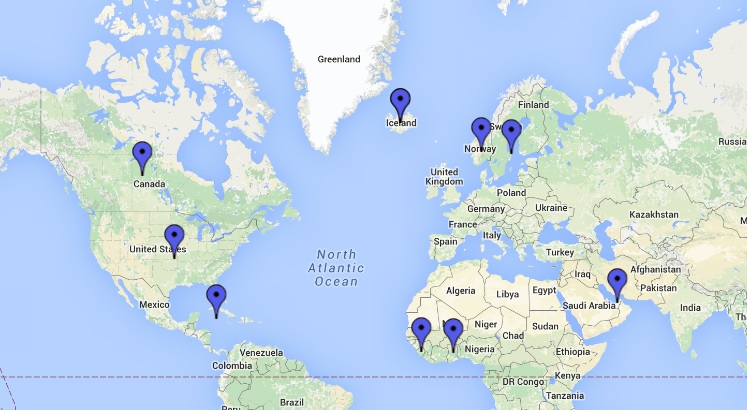
The reception has been amazing.  At the time of this post, we have enrolled educators from:

Abu Dhabi, Cayman Islands, Iceland, Ghana, Canada, United States, Norway, Sweden, and Sierra Leone.


From the CLP document:

If you are interested in becoming a member teacher and/or school, you will need at least one staff member to complete the registration form. There is no limit to the number of staff who can register from your school. The more teachers that register, the more opportunities that are created for connected learning partnerships!

Please help us grow the CLP Program by sharing this document with your colleagues around the world. The CLP Contact List will go live beginning September 1st 2016. If you have any further questions, or would like to provide us with some feedback, please feel free to contact us by email.

We would love to have you add your name to the list.  We would love to have you share the document with others.  We would love to have champions in other continents help us to connect with others around the globe.

Join us!

See it here at
Connected Learning Partnerships

Current CLP countries

Thursday, 26 May 2016

Create Purposefully: Matone de Chiwit

 
I have had the pleasure of being able to watch my students develop a relationship with Karishma Bhagani, an NYU student from Kenya who is the founder of Matone De Chiwit.  I shared about her desire to bring her invention of an inexpensive water purifier back to Kenya and to other countries desperately in need of clean water in The Precarious and Powerful.  I used that title because I wanted to get across that with connection comes risk. . .but also power.  I ended the post with a caveat about relationships: don't go into them blindly, but don't let fear stop you from making them.

As the month has carried on, my students have been working collaboratively to make responses to Karishma and her passionate provocation of helping aid the task of getting clean water to those who don't have access to it.  Without further ado, here are some of our purposeful creations to help Karishma's campaign to provide clean water in the areas that most need it.

Commercial to raise awareness about water scarcity and to raise support


Posters to support Matone de Chiwit
 
"We wanted to create this poster to see if Karishma Bhagani, the person the created the water filtration system, would like to use it for advertising her project. In our poster we included what Karishma made, who it is for, and most importantly what YOU can do to help."


Social Media Campaigns
 
"Karishma said that she had people working on her Instagram. We thought since Karishma didn’t need someone to make her an Instagram, that we should help promote what Karishma is doing to help."


Work on the Website Creation
 
"For the Matone De Chiwit, Hailey, Athena and myself are working on a website to spread awareness about Karishma’s campaign. we have been working very hard on the website design so far with Karishma. we have been back and forth for a couple weeks over email."


In Connections-based Learning, its relationships that are the focus.  Each facet of the teaching and learning process leverages connection for learning.  Whether it is the gathering of information from experts, the formation of meaningful creations that serve a purpose, the sharing out of the process, or the feedback received by others, connection is at the heart. I hope that you can see in these responses how connection is not just weaved in throughout the process but provides the foundation for each action.  Purposeful creations stem from connection as we serve, support, partner and question those with whom we connect.
 
We are so thankful to be able to have the opportunity to partner with Karishma and help fight against global water scarcity.  We wish her well as she continues to be a force for positive change in this world!


Tuesday, 24 May 2016

Getting connected: Finding Experts


I recently had the pleasure of sharing Connections-based Learning with my alma mater.  It was great walking back into the high school with its quadrangular layout and large spacious halls.  I strolled into the library where I would present and the smell took me back to carefree high school days.  A buddy and I would spend our free blocks in the theatre.  If you can imagine it, we would rarely be on the floor.  We would hop from armrest to armrest up, down and across the banks of seats.  The biggest challenge was when we hopped over the aisle into the next bank of seats, from armrest to armrest without skipping a beat.  Thinking about it now it was recipe for ankle pinnings and neck collarings.  For us then, it was something to master, a challenge to overcome, a way to demonstrate expertise.


Every time I have shared Connections-based Learning with educators, I have videoconferenced in an expert.  I not only want teachers to learn about connected encounters but to experience them.  This time we had the pleasure of bringing in Melissa Lavoie (blog: https://adventuresineduteching.com/).  Melissa is an engaging passionate connected educator working as an educational technology special assignment teacher in Timmins, Ontario.  She shared a wealth of ideas and experience with us that ranged from Google Apps for Education to inspiring connected experiences.  I believe the big take-away for the Centennial High School staff was the three places to find experts that Melissa shared.
 
 
When I first heard about the digital Human Library, I knew that I had to share it with as many people as possible.  I immediately signed up and put the link on the Connections-based Learning site. When I got to connect with the Founder, Leigh Cassell, I realized how special this endeavor really is.  I ended up featuring one of her stories in a post on Inspiring Creative Connections.  The digital Human Library has hundreds of experts in nearly any subject area available to be signed out by teachers and classrooms to share their expertise with students.  It also has links to hundreds of free multi-media tours.  It is a one stop shop for getting connected and leveraging those connections for learning.  Using the dHL to connect students with experts allows for an amazing experience, but Melissa shared with us how she took it one step further and used a dHL expert to share with teaching staff. 
 
For a professional day, Melissa brought in an actor to a staff via videoconference.  The actor shared with the educators not only his story as an actor but got the educators on their feet (and a bit more comfortable in their skin) doing warm ups and improvisations.  Melissa was able to bring to the staff an expertise that she didn't have, a connection that got even the most resistant moving by nature of the authority and experience of an expert.  The experience also shared the power of the digital Human Library use itself.  The educators walked away having been stretched both physically and mentally.
 
 
Making popsicle stick bridges is a great way to teach compressive and tensile strength and the advantages and drawbacks of certain geometric shapes in construction.  Students love heating up the hot glue guns and bringing their structural ideas to life.  I have done this exact activity with my Science and Tech 11 class.  But when I heard about what Melissa did with the activity, I realized how a connection can expand just about any learning experience.  Melissa used the VROC connecting platform to find Professor Francesco Tangorra, a civil engineering instructor from Algonquin College in Ottawa, to join the class with which she was working. (Story on p. 24/25 here).  Virtual Researchers on Call is a platform that connects STEM professors and professionals with Canadian students for interactive learning.  What the engineer did was amazing. 
 
As each student brought their bridge up for testing and applied weights to the structures, Prof. Francesco would be observing via Google Hangout.  When the structure failed, the engineering instructor was able to tell the students where and why the structure broke.  He would share his wealth of knowledge and experience with the students expanding their ideas about what makes structures strong.  The students were completely engaged in the project and came to better understand the artistry and science that goes into making bridges.


The final platform Melissa shared about that connects students with experts is Exploring by the Seat of Your Pants.  This platform is focused on Science, Adventure, and Conservation.  Melissa shared about an encounter where students were able to experience river rafting through the platform.  Amazing!  Each experience is stored as a Youtube video in the Exploring By The Seat Of Your Pants Youtube channel.  Check out some of the videos as they really give you a perspective on how engrossing this platform is.  Give your students the opportunity to go to the bottom of the ocean, a turtle hospital, a bug zoo, Iceland's glaciers or many other locations with this far reaching platform.
 
One of the four CONNECT facets of Connections-based Learning is Question Experts.  In this day and age with innovative platforms such as these, experts in any area are not far from the students.  I encourage you to take advantage of this connected world and share ideas from willing experts with your students.  Keep me posted about all your incredible connected experiences by sharing in the comments or tweeting out to #CBLchat.
 

Monday, 2 May 2016

The Precarious and Powerful


As I continue to share about Connections-based Learning, I've been emphasizing that connections are powerful.  They tug at the heartstrings of students, relationships form, nitty-gritties are opened up.  There's exposure, bonding, revelation, a call to action.

It's like setting up an introduction for your bestie.  It could end up being just a single thorny encounter.  Or it could go all Beaches and last a lifetime.

So be careful.

This was clearly illustrated in my class' most recent connection with Karishma Bhagani.  Karishma is an NYU student who has invented an inexpensive water purifier that she is hoping to produce on a large scale and provide to needy villages in her home country of Kenya.

As we were approaching Earth Day, Fran Siracusa of Calliope and Jennifer Casa-Todd made me aware of the connection they had with Karishma and how she wanted to share her invention and her passion with students.  The water purifier initiative is called Matone De Chiwit.  Fran and Jen were encouraging classes from all around to make contact.


Matone - "Drops" in Swahili
De - "of" in Spanish
Chiwit - "Life" in Thai

Karishma believes that for a global project like this, a global name that includes the languages of countries most in need of clean water would be appropriate.  Thus: Matone De Chiwit.

I thought this was a perfect connection for my class to make.  We set a date for a GHOA and despite the fact that it was after school time to fit Karishma's schedule, the students were very excited.  They were very patient through initial technical issues and listened intently as Karishma shared her story.  They were ready with questions in order to dialogue further.  As always,  I was impressed with how students stepped up to the plate when communicating with the outside world.  When Mo asked if Karishma thought that Kenya was overlooked in terms of aid and I listened to the ensuing conversation, I really saw how CBL gives a voice to people, whether my own students or the associates with whom we connect.

Our GHOA with Karishma

Here are a couple student posts on the connection:
- Hailey's post
- Quinn's post

The Hangout was the provocation.  The call to my students was: now that we have heard this message, what are we going to do about it.  I left it pretty open, and I said that students could take it as far as they wanted.  They took it further than I could have imagined.


Students are:
- sharing Karishma's message through social media
- sharing the message through posters and posts
- creating Youtube videos
- creating commercials

Not only that but one group of students is collaborating with Karishma to build her a website.  Emails have gone back and forth; they are working on website design; there's plans to consult with the team's artistic director.  There's involvement, investment.

Here is a post from one of my student's digital portfolios:

"This project that we are working on is not only making an impact on the world but it is also impacting me as a person. It is making me step out of my comfort zone and use my head to think about each individual step. Starting this project I decided it would be beneficial to read about the problems that we are trying to help. After reading articles, web sights and papers I have a new found appreciation of everything that I have in my life, and I no longer take things for advantage like I would have yesterday. Now instead of hearing about the struggles people are facing and feeling bad for them, I am making a contribution to one day end those struggles. I will no longer be the person that will stand aside and watch things happen."
- Hailey Smith

These students are working on relationships, developing a world view, letting out their compassion. 


I say be careful when facilitating connections.  But I wouldn't have it any other way.

Tuesday, 22 March 2016

Inspire Creative Connections

 
Students' minds should be blown on a regular basis.

The possibilities of what could be should be expanded for our students as often as possible.  When opening up the doors to connection, I want students to think that anything is possible.  When starting a CBL, the first order of business is to inspire creative connections.  When an educator has ignited that spark within the student, the job gets a lot easier.  In a CBL, that spark is the connection.  What follows are some snapshots of inspirational connections. These can be shared with students and teachers alike as we strive to open the doors to meaningful relationships among students, experts, organizations, the community and around the globe.

Inspiration: Rola Tibshirani's Grade 6 Class


When I was asked to hold a Connections-based Learning workshop, I realized that it was hugely important to not only share about CBL but to give my attendees the experience of CBL.  I quickly tweeted Rola Tibshirani and asked if she would Skype in to my workshop.  It was amazing.  It wasn't just that I saw how the workshop became alive as we connected with another educator on the other side of the country, it was the students on the other side of the country that made the experience amazing.  They were sharing a contagious passion regarding the connections they had made throughout their class time with Rola.  Deeply inspiring.

These students were using their 3D printer to make letters to support the work the educational assistants were doing to help struggling students learn letter writing at the school.  These students were connecting with a local banker to support their entrepreneurial projects. These students were connecting with the UN to follow their own passion projects to help accomplish Global Goals.  If you keep your eyes on Rola's classroom posts and tweets you will see a constant stream of interaction with experts, organizations, and the community around.  It's like they're the NCIS special agents up in MTAC room. They are truly inspirational.


Inspiration: David Billikopf's students in a correctional facility

Connections-based Learning should open doors to opportunities that would not be possible without a connection.  David Billikopf teaches at a correctional facility.  He wants to see his students have real life discussions that matter to them.  Not only does he want his students to connect with others while they learn, but he has the added challenge of maintaining confidentiality and student safety with those within and without the prison.  Through creative connections, he has been able to have his students interact with students around the world giving them meaningful true to life learning experiences.

I stumbled onto his work when I noticed a tweet asking if the students ever got days outside the prison.  Through following that twitter stream I was able to watch as Mr. Billikopf's students interacted with a class from Norway, sharing their experiences as students inside and outside prison, sharing poetry, sharing words of encouragement.  I was able to watch as these students built understanding and acceptance.  They became learning partners, spurring one another on.  It was moving just to see this from afar.  As one commenter wrote on Mr. Billikopf's blog: I would not be at all surprised if someday they make a movie out of your successful and most creative project. Congratulations!


Inspiration: Leigh Cassell's Grade 2 Class


Every time I've shared this story from Leigh Cassell, people have been moved.

It is about a globally connected educator who connected her class up with a class from Sierra Leone.  They built up a relationship exchanging letters and learning about each other.  The experience was eye opening for the students as they shared about their respective cultures and traditions.  The students developed a relationship that year that superseded culture and distance. Their connection with "Communities around the World" had been life-changing.  Tragically, a year later disaster struck.

After hearing the devastating news that the class in Lakka, Sierra Leone with which the children were connecting had experienced traumatic consequences as the result of the Ebola Virus, the students' response was: "What are we going to do to help all of the people who are still alive in Lakka?"  A relationship had been built that they couldn't ignore.  The students created posters showing the children there how to prevent the spread of disease: washing hands and sneezing into arms to stop the spread of germs.  Ms. Cassell's students had to do something.  These were not simply unknown students miles away who experienced calamity, these were students with which they had a bond, a bond that lead to understanding and ultimately, compassion.  Is there anything more important that we can do with the 200 days we spend with our students?

And there are more and more inspiring connections that I'm just bursting to share about.

I wrote this on Leigh's blog.

It causes me to think:
- if you don't connect, you can't help.
And
- if you don't share your story with the masses, we all miss out.

This is connection.  This is relationship. This is making a difference.

Wednesday, 24 February 2016

Get in the pool!


I spend a lot of time reading educational blogs.  Just as we all would want our doctor to be up on the latest medical discoveries and innovations, I believe we would want our teacher (or our child's teacher) to have an understanding of the latest developments in learning.  It's not about adopting and incorporating everything; it's about listening to and learning from the conversation.

But it's also about being part of the conversation.

I was reading a George Couros' blog post called Figuring It Out for Themselves? that talked about student connection. He made a case for not leaving the facilitation of student connections to a few in the school, but opening the door to everyone having an influence on it. 

Now I am all about connections. And it's not just people. I love that my phone is connected to my music which is connected to my speakers which is connected to my movies which is connected to my TV which is connected to my pictures.  I love when I see a student's learning on their digital portfolio in a post that has an embedded movie or game that they have created on one of their beloved apps and I make sure that I tweet it out or put the link on a Flipboard. Connection: it's just one thing I delight in.

And I have been developing my chops in facilitating student connection.  We have connected with a planetary scientist, a cancer survivor, a stem cell researcher, a food banking organization, business start ups, non-profits and more all in the name of helping, learning and growing.

Needless to say, the post caught my eye.

George was responding to William Chamberlain (coiner of the #comments4kids hashtag) who excellently shared that posting does not mean connecting.  I agree.  In the 21st century the web truly goes both ways.  Web 2.0 is about connecting.  Not only do my students get to receive but they get to give!  I love the fact that this picture was taken as my students were sharing their knowledge of project-based learning over Skype with the folks at FreshGrade. I love that FreshGrade was interested enough to ask students what they knew. Amazing!


There's a to and fro, a relationship, a connection.

A swimming analogy was used in George's post. The quote was:


There was talk in the comments around what that teaching would look like: scaffolding learning, explaining acceptable use, the gradual release of responsibility.  I was surprised, though, when the analogy didn't get to its logical end:

Get in the pool! 

Now I have watched a lot of swimming lessons. And let me tell you, something happens when your kids take Swim Kids 4 for the fourth time. At times your hand reaches into your pocket to feel for a $20 to grease the teenaged instructor's dripping palms to end the madness and it is only halted when you awaken from your chlorine induced stupor with the words: "Dad, it's done. I'm freezing. Let's go."  Anyways.  In all those times, rarely have I seen a dry swim instructor. And if it does happen, it's likely some kid with a cast on his arm whose hanging on to his $15/hour job for dear life despite the skateboarding injury.

They are all in the pool.

Lessons on developing our ability to connect meaningfully are better caught than taught. Are you watching the action go by or are you part of it?

Are we creating opportunities to model online interaction with our students?
Are we part of a developing culture of sharing at our schools?
Are we opening the door to student connections through back channeling, cross commenting, collaboration? Do we participate in it?
Do we make time and space for global connections?

If we prize connection and want to see our students connect, we've got to be part of an atmosphere of connection.  We've got to jump in the pool.

[photo, “Lion's Pool Aug'13“, by Lontzman Katzman licensed under CC BY-SA 2.0.]