I would like to start this year off with asking you what you think connections-based learning is. I have spent many years talking about this approach to teaching. But teaching is not about one person spouting off ideas. It is about the transmission of those ideas and the meaning made within everyone else. For this post, I want to share some resources that can help you make meaning from the idea. My hope, though, is that you share your ideas on the approach as we learn and make meaning together.
The CBL wikipedia article gives an outline of the approach as well as how it differs from other 21st century approaches to teaching. It allows for others to share their thoughts, add their ideas, submit their examples. Like all Wikipedia pages, it is a work in progress that blossoms as others add to it.
Getting our terms straight is an important part of communication. I appreciate Kenneth Muhumuza reminding me of this post regarding just that:
#CBLchat: My team @serveUganda and I would like to introduce connections-based learning @teachCBL in Uganda and start training teachers to embrace it. This kind of learning has potential to solve many challenges especially in the developing world. Join the community!#TeachSDGspic.twitter.com/fGydPZ0GqJ
I am so thankful to have been able to paint a more complete picture of my thoughts on CBL with the Connections-based Learning book. I have tried to make this book accessible to as many as possible. Not only am I able to share examples of CBL in action with this book but in the Kindle version, there are links to Twitter hashtags (like #CBLchat and #CoConstructGoals) to allow the conversation to deepen. This is a great starting place for anyone wondering what connections-based learning is all about.
Connectionsbasedlearning.com is also another place to visit on your CBL journey. It outlines the three focuses of CBL: connect, collaborate, and cultivate. It shares ways to connect. It contains research and resources. It is a great spot to bookmark and refer back to.
And many more resources exist to add to your knowledge of connections based learning:
In the end, CBL is what you make of it and how it plays out in your classes. Join our Voxer chat community here: #CBLchat Voxer Community and share what you think connections-based learning is. Or share your thoughts on Twitter using the #CBLchat hashtag. Find me on Instagram at TeachCBL. Comment below. But please, share your thoughts!
My Science 9 students are well on their way with their Connections-based Learning to help the bateyes of the Dominican Republic with the problem of light poverty. I shared how this CBL came to be in Doing Something Beyond Ourselves. At that point, I had a few ideas on where I wanted to take my students, but it was all speculation.
Now the students have been unleashed. Connections do that. They catch students right where heads meet hearts. They reveal a compassion that might hide dormant without prompting. Connections fan the flames of empathy and lead to action. Learning becomes a necessity, not an assignment.
We had two amazing Skype chats focused on light poverty. You can find a taste of these chats on these student posts:
The Connections-based learning Collaboration Lens helps educators steward the connection. It is one thing to make an amazing connection with the community, an expert, an organization or another group of students. It is quite another to maximize it for learning.
I want to share how we used the CBL Collaboration lens to take us from connection into response. It starts with the Design focus and specifically Empathizing local and global needs.
Empathize local and global needs
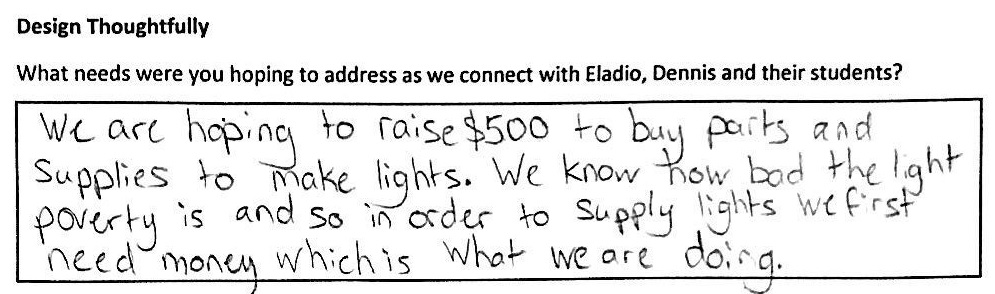
Seconds after our Skype chat was over with Eladio, Dennis and the students from the Dominican Republic, we were talking needs. Now the needs might be a little more obvious when we are talking about the people living as sugar cane workers in the Dominican Republic. There might be one or two hours of electricity a day. There might be none. And if electricity is available, it is during the day. Light at night is a real issue and affects both learning and safety. It was hard to hear about people dying in fires as a result of candle and kerosene lamp use at night from Dennis during our Dominican Republic Skype chat.
But empathizing needs looked vastly different for the SSEP CBL my students did. In that case, our experiments would never get on the Space X rocket if they didn't address a need. The need gives meaning to the action. It gives meaning to the making. The need has to be there. Without it, why bother.
My students went through a whole CBL process as they designed their Engineering Brightness learning experience. The first thing was to reflect on the connection, ponder the needs they discovered, and develop the learning goals they have for themselves. Here are some student samples:
With students discovering needs through the connection, the next step is to Co-construct Learning Goals. I will continue to share as this CBL develops. Look for the next post: Co-construct Learning Goals | #CBL Collaboration Lens.
Consider partnering with us as we fight light poverty in the Dominican Republic.
We all have some intuition about the fact that the 21st-century connected world has opened doors to new ways of looking at teaching and learning. We all feel like there is potential to tap into. We might not know how to do it, but we often catch wind of something amazing going on. We are asked to make our teaching more relevant, more personal. We may not feel like we have the tools to do it, but we feel the pressure with this felt potential.
We also know that this potential goes beyond simply what technology offers. It is the human element that makes the difference. It is not enough that online games are more engaging, that apps are more intuitive, that our devices are more powerful. We recognize that education is about the heart. Therefore, it is not about the games, apps and devices, but more the doors those games, apps, and devices open. What, in the end, do they do for us? And how do they help us get to a place of meaning. Really, in education these days, the question has to be: what matters?
I have been trying to share an approach to teaching that can give us a framework regarding answering that question: forming learning relationships needs to be the foundation of learning. Learning must be based on making human connection. I have called it Connections-based Learning I also recognize that there are many terms out there that have been used to add meaning to the idea of connecting our classrooms.
The first order of business should always be to define the terms. What I would like to do is to look at the terms surrounding connection in education to help us reach some common language. The terms Connected Learning, Connections-based Learning, Global Education, and Connected Education are not synonymous. They each have their focus and I will attempt to give each term a solid spotlight in order to clarify the connected landscape.
Connected Learning is a type of learning based on student personal interest. Connected Learning - an agenda for research and design states that "Connected learning is realized when a young person pursues a personal interest or passion with the support of friends and caring adults, and is in turn able to link this learning and interest to academic achievement, career possibilities, or civic engagement." - (Ito, M. et al., 2013).
It is a perfect marriage of peer involvement, interest pursuing, and academic engagement. The focus of the process is not on a certain structure (Ito, M. at al., 2013, p. 45), but more that students' learning happens in the context of pursuing shared interests and goals.
It has a focus on educational reform which includes addressing and eliminating ethnic achievement gaps. The desire is to "bring together in-school and out-of-school learning and activity." and form deeper bonds between different spheres of learning.
Examples of Connected Learning:
"Examples of learning environments that integrate peer, interest, and academic pursuits including athletics programs that are tied to in-school recognition, certain arts and civic learning programs, and interest-driven academic programs such as math, chess, or robotics competitions. These connected learning environments embody values of equity, social belonging, and participation." - p.8 (Ito, M. et al., 2013)
Connected Education has a focus on online learning activities. The term Connected Education was first used in conjunction with personalized learning in the form of online lessons describing the groundbreaking work of Paul Levinson and Tina Vozick. In the 80's, they created masters degree programs that could be completed online. The term Connected Education continues to be used to describe any kind of learning that uses the internet in some capacity.
Here is a 2008 Connected Education video on digitizing lessons. The early focus on Connected Education was to have video lessons readily and easily available for learning.
In the article What connected education looks like - 28 examples from teachers all over, you can see connected education as:
- utilizing learning networks such as Edmodo
- compiling pictures that students take with their devices around a certain topic
- collaborative projects with other classes
- educators blogging about classroom experiences
- district-wide twitter chats
- creating web-based lessons
- sharing educator resources using online bulletin boards like Padlet Global Education
Global Education has a focus on seeing the world as a whole. Learning about the world, its needs, and what must be done to meet those needs is key. In the province of Alberta, we have the Centre for Global Education. This Edmonton Public Schools organization provides opportunities for students to learn about global issues and "the potential youth have to shape a common future" through online conferences and interactive sessions. You get an understanding of Global Education as the TCGE describes its mission:
"The mission of The Centre for Global Education (TCGE) is to educate 21st Century students for a 21st Century world by providing global learning opportunities, enhanced through technology, informed by sound research and innovative teaching."
In Atlanta, Georgia there is The Consortium for Global Education. Their desire is to provide opportunities for students and teachers to help develop global worldview through school partnerships, student exchanges, and collaborative research.
The Centre for Global Education in Belfast focuses on achieving a "just and equitable world". They remind us that part of Global Education is to influence leaders and policy makers, to support organizations that foster social and economic equality, and "to promote an understanding of the interdependency of people across the world."
Examples of Global Education:
- learning about the social and economic needs of another country
- student trips and exchanges
- raising funds for relief organizations
- campaigning for social and economic equality
- service projects that meet needs in a key area of need
- learning global citizenship and sustainable lifestyles
Connections-based Learning Connections-based Learning is an approach to teaching and learning that leverages the connected world by connecting students with their community, learning from experts, supporting organizations, or partnering with peers.
While Connected Learning uses connection to support students' own interests, Connections-based Learning has connection running through every facet of the process. Connected Learning is a more free flowing process that harnesses a student's everyday experience while Connections-based Learning focuses on connecting students with learning or action partners. Connected Education includes utilizing apps to maximize learning; Connections-based Learning uses apps to promote connection to maximize learning. While Global Education often includes a true connection with others outside the classroom, Connections-based Learning must include a connection. Global Education looks outto find the needs of the world; Connections-based Learning looks around finding connection anywhere--from home and the community all the way to the ends of the earth. For Global Education, learning is focused on the world and its needs; Connections-based Learning could include learning about stem cells, or white water rafting, or Mars.
The infographic below clearly shares the nature of Connections-based Learning. This infographic was created in collaboration with Leigh Cassell (see her amazing resource called the digital Human Library) who had a huge hand in the images, wording and focus of this resource.
Clarity is crucial as educators. And without a common language, we are not truly communicating clearly. As connected educators, let's work together to achieve a common understanding as we seek to make better teaching and learning. Please share your thoughts!
References
"Connected Learning". Wikipedia: The Free Encyclopedia. Wikimedia Foundation, Inc.Mar. 8, 2016. Web. Aug. 31, 2016.
Ito, M.; Gutiérrez, K.; Livingstone, S.; Penuel, B.; Rhodes, J.; Salen, K.; Schor, J.; Sefton-Green, J.; Watkins, S.G. (2013). Connected learning: An agenda for research and design (PDF). Irvine, CA: Digital Media and Learning Research Hub.
Here is a candid conversation about why not to embrace Connections-based Learning. At the risk of setting back a movement I started only a couple of years ago, employ in my classroom, share about at workshops, and blog about frequently, I really want to take a hard look at some reasons why Connections-based Learning might not be for you or your colleagues.
As I sit here up on the top bunk in my hostel room (enduring the snoring and. . .) joining the 14,000 educators in Denver at the ISTE conference, I think about the amazing possibilities that a #CBL lens would have on teaching and learning. But still, I will carve out my top 5 (but I am sure there are others) reasons not to embrace Connections-based Learning.
#1 you'll have to be open to increasing your network
Connections-based Learning is actually what the name says: it is an approach to teaching and learning that is based on connections. In fact, as I have been delving deeper into what is and is not Connections-based Learning and spending time re-imagining the infographic (and in turn deepening the whole approach) with Leigh Cassell, I have become even more adamant that if it doesn't have to do with connection, relationship, partnering, and interaction, it has no part in the approach.
That being said, educators involved in #CBL will not be able to avoid the networking aspect. Time will need to be taken to pursue connections. Effort will need to be expended to contact partners (through avenues such as Connected Learning Partnerships). These connections will have to be managed and cared for as any relationship would. These connections would be two-way, not a flash in the pan, but more the slow cooking turkey basting variety. And Connections-based Learning will require emotional energy to deal with the exposure to the many views and possibilities that a deeply connected educator will come across.
#2 you'll spend more time creating educational experiences
You'll have to take a look at your curriculum and ask yourself, "how can these learning outcomes be achieved in relationship? What are meaningful activities that provide the experience that will allow my students to come away with this kind of understanding.
When you collaborate on something, it requires planning ahead. You have to interact before you interact. And when other parties are involved in the planning process, there's give and take about the what's, where's, and when's of the process. You are going to have to navigate that.
Moreover, some of your learning outcomes might just not seem to fit with a connected experience. You'll have to figure out what to do with that. Connections-based learning will challenge you in ways you may not want to be challenged.
#3 you'll have to take risks
First there's the tech. Collaborating can include some kind of video conferencing if global connections are pursued or experts are brought in from far away. The technology has to be learned and then executed in real time. And when the tech seems to be failing, you're still on. It's like you are hosting a dinner party and there's not enough food, uncle Larry's going off the deep end, and Sarah threw sand in her cousin's face. Can you smile, dig out some poppers from the deep freeze, put Larry in front of the TV, get Sarah to apologize while setting up a temporary eye wash station, and go without food yourself all without losing your smile?
Then there is opening the door to students interacting with organizations, experts, and partner classes. When my student Mo asked Karishma Bhagani, an NYU student hoping to bring her invention of a $10 water purifier back to needy villages in her home country of Kenya, about her thoughts on the aid western countries offer to the developing ones, I had no idea what to expect. Would she be caught off guard, offended, made to feel uncomfortable? Connections-based Learning will lead you into a pattern of risk taking. How will you deal with that?
#4 you'll have to give up more control
The most effective #CBL's I have participated in have been the ones where students create their own goals around an interaction. Can you give up control to your students and have them own the learning. They might not head in the direction you were hoping. And do you really want your class to have the feel of some kind of campaign headquarters? Are you okay with students heading off in different directions all at once? Can you facilitate over orate, listen over speaking, and give up the idea of covering off your curriculum? #CBL will ask you to do all these things.
#5 you'll risk getting involved
The year is done and summer has come. And still Hailey and her partners are working on Karishma's web page. In fact, I remember the call home letting the parents know that their daughter was interacting with an NYU student on her own. I had to make sure it was okay. But I also remember our shared delight, talking about a young person who has found a passion, who has made a resolve to no longer stand aside and watch things happen.
But connections-based learning is about so much more.
When students are partnering with other students, a different facet of learning is taking place. They move from reception to reciprocation. When my students partnered with Matone de Chiwit, one aspect was assembling ideas on a shared Padlet. We got to see the ideas that the Florida students were working on and add our own. Inspired by this interaction, here is what we did.
So when Leigh Cassell approached me with the lofty goal of creating a list of educators willing to partner with learning endeavors from every country in the world, I knew that this had to be done.
Learners partnering locally and globally can lead to so much.
- empathy for others
- synergetic accomplishments
- comparative research
- positive relationships
- a global worldview
...and so much more.
So with that partnership between Ontario (Leigh, and Nicole Kaufman who joined the quest) and BC (me), came Connected Learning Partnerships.
The concept is so very simple yet so powerful: create a spreadsheet of interested educators across the globe who are willing to partner with others. The only thing we request is that if you are approached with a connections-based learning idea, that you respond back: "Sure, let's do it." or "No thanks."
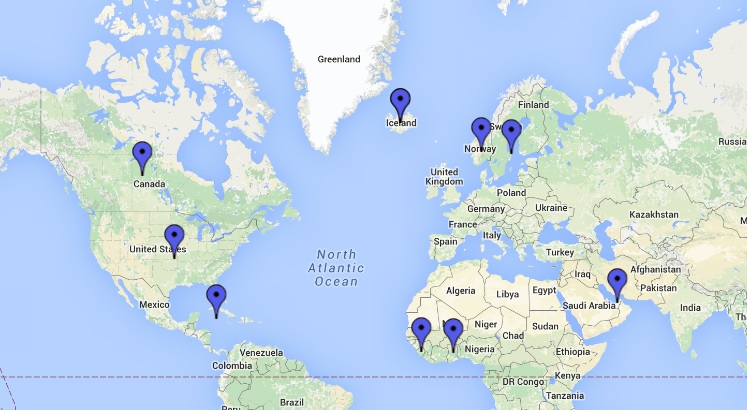
The reception has been amazing. At the time of this post, we have enrolled educators from:
Abu Dhabi, Cayman Islands, Iceland, Ghana, Canada, United States, Norway, Sweden, and Sierra Leone.
From the CLP document:
If you are interested in becoming a member teacher and/or school, you will need at least one staff member to complete the registration form. There is no limit to the number of staff who can register from your school. The more teachers that register, the more opportunities that are created for connected learning partnerships!
Please help us grow the CLP Program by sharing this document with your colleagues around the world. The CLP Contact List will go live beginning September 1st 2016. If you have any further questions, or would like to provide us with some feedback, please feel free to contact us by email.
We would love to have you add your name to the list. We would love to have you share the document with others. We would love to have champions in other continents help us to connect with others around the globe.
I believe it was Plato who said that no person can go into the same river twice. Not only has the river changed since the first entry, but the person has changed as well.
A few months ago, I changed the name of my blog from "On the side of technology" to "Connections-based Learning". I'm not sure of the effects of a name change in Blogger, but for me, it helped clarify what I'm working on.
I started this blog with a focus on tech in the classroom. It was only a few years ago that I did the unthinkable (at that time and place) and allowed students to not only use their cell phones and tablets in class, but to use them for learning. I was "on the side" of using technology in the class. I also thought that the name leant itself to other blogs ... "on the side of..." whatever else I was into.
As my learning morphed and changed I was really taken by what this connected world did for propelling my thinking. When one is faced with an almost endless supply of ideas on social media, it's hard to ignore the disparage between the status quo and the "what could be".
I want that same thing for my students.
I want them to be able to see what is really out there and be compelled to:
- embrace it
- change because of it
- have an effect on it
Connections-based Learning was born out of my desire to take Project-based Learning to the next level. The true learning that comes from a genuine project is through relationship. How are we fostering these connections in the class in everything we do, not just the projects we take on?
The Connections-based Learning infographic and the Whiteboard Interactive video have been ways to take a snapshot of what this new focus on learning is about.
Serve the Community. Plant a garden where there isn't one. Sing at a retirement home. Work on making the environment better.
Help Organizations. Raise money for non-profits. Test out products for startups. Hold workshops for companies.
Question Experts. Email questions to experts in a field. Have projects that ask students to seek out experts. Skype in experts into the class.
Share the process. Present to the class your findings, whether your connections panned out, or didn't. Record your learning in a portfolio. Share what you're doing with the rest of the school.
Show the World. Tweet out the learning. Get feedback from outside the class. Seek out a genuine audience.
All these action steps, my classes have done and I can attest to the meaningfulness of the activities and significance of the learning.
But to the last of the 6 facets: I had "Work as a Team". This was a carry over from my project-based learning focus: students working in groups to achieve project goals. I want to capture something else, though. Yes, I still think that group projects are worthwhile for many reasons. But learning activities don't have to be in a group. Sometimes it's me who brings in the expert. Students collaborate to create questions but it is different than the standard group project. I want students to read and respond meaningfully to each other's learning blogs. This is also a different focus from group work. So I've changed the sixth facet to "Feedback Meaningfully" using feedback as a verb. It's a little clunky but it gets across the point. There's probably a better way of saying it out there. Maybe you've got a suggestion?
Defining Connections-based Learning is a work in progress. But I think you know it when it is happening. It is defined more by classroom feel and student buy-in. True experts are sharing with your class. Students are involved in making a difference.
I am ready to take CBL to the next level. I am hoping to find some educators out there who have been looking for a way to push their learning, a way to describe the changes in their teaching as a result of wading into this connected world. Are you ready to jump into this river with me? Connect with me if you are.
Learning begins with a good question. Preferably one you have absolutely no answer for.
In Connections-based Learning, the process starts with a desire for students to seek out meaningful connections. The first action is to ask a question that opens the door for those connections. I wanted my students to learn about re-world electricity use, so I asked this:
Basically I asked: "With whom can you connect to learn or do something about electricity?" I was shocked at how far my students would take this. . .all the way to Poland.
Experts
A Skype chat with an employee in a Polish electrical company where
we learned that 80% of Poland's electricity comes from fossil fuels
One group had a connection with someone who worked in the power industry in Poland. A Skype chat was set up and the class not only learned about Poland's electricity situation but about Poland itself. The real-world connection brings an understanding of what is going on currently, not what was happening at the time the information was written. CBL also gives the students a chance to speak into another's situation. Questions were posed as to what Poland's future plans were to get them to move to more renewable energy sources. Our students got to share there concern about the environment and encourage the seeking out of better ways to produce electricity.
Organizations
A depiction of a real-life BCHydro interview produced using IMovie
Connecting with experts is just one avenue students can take in their Connections-based Learning. Another possibility is to work together to strive for real-world change. In this particular activity we had students trying to hook up generator companies with homeless shelters. We had students contacting Me to We and Clean Energy BC, hoping to have an influence on the building of more wind farms.
I love the creativity students use to share the story of their experience. One group interviewed our own BCHydro producers of electricity. They put together a mock up of the interview in an IMovie that they put on their blogs. Another group shared their interview with a BCHydro employee in the context of developing a Power Outage Safety Kit. In CBL, it is great to see what type of angle the students use to communicate their learning. Not every organization responds, but the requirement is to tell the story around the connection. What was learned through the process?
Community
An interview with our principal on our school's
power conservation actions and hopes for the future
We also had students looking to our own school, wanting to ask what we were doing to steward our energy use and what the future holds for better school-based conservation. These students interviewed our principal and shared school priorities for energy use, plus dreams for the future, including device charging stations hooked up to stationary bikes.
Connections-based learning is about sharing out our experiences. This is often done through our digital portfolios. One really cool thing that came from this #CBL was that one of the students wrote an article for the school newspaper on her #CBL experience. You can find the article here.
Connections-based Learning prizes re-world connections. Open the door wide to leverage those connections for learning.
We are all looking for something to base learning on. We
see it in the contemporary educational titles: project-based learning, passion-based
learning, competency-based learning, inquiry-based learning. These titles may seem like buzz words but
they are important; they set the tone for teacher conduct, curriculum foci, and
student actions. Should we base our
learning on projects? Passions? Competencies? Student inquiry?
Each of these educational titles is a way to guide the
priorities of our pedagogy. “Blank”-based
learning methods, in particular, are an attempt to describe a learning process
that is meaningful to students. With
project-based learning, genuine reality-based projects become the vehicle for
learning. With passion-based learning, students’ passions are leveraged for
learning. In competency-based learning, learners
focus on progressively mastering smaller elements of a greater learning
objective. And with inquiry-based
learning, students form skills around developing great questions that can’t
simply be “Googled”.
With all these methods of structuring learning, it begs the
question: do we really need another ‘blank’-based learning?
Ponder how these meaningful learning approaches include interpersonal
connection. In project-based learning,
we see collaboration as an important element.
Students often work together as part of a group while completing projects. Imagine how better the process might be if the
focus of student activity includes fostering effective collaboration among team
members, building relationships with community partners and topical experts,
and sharing learning with the world. It would
take project-based learning to the next level.
We also see connection in passion-based learning. An environment where students feel connected
to one another provides the safety to reveal passions. Is it possible to take this further? As student
passions are discovered, embraced and leveraged during the school year, could groups
with common passions work together with outside organizations to achieve common
goals?
The mastery focus of competency-based learning requires a
good teacher-student connection.
Understanding where students need to work is a key component. Students who have mastered a certain concept shouldn’t
be inundated with its lessons. Students
need to work on concepts that are tailored to their needs, not a one-size-fits-all
shotgun approach. Without a great
teacher-student connection, these needs can go undiscovered. Imagine the effect of a teacher focused on
making a strong connection with each student and supporting students as they
discover their own target zones for learning.
And connection is also found in the tenets of inquiry-based learning. A sense of community and connection is
crucial as students develop and share their genuine questions. Could the students build a connection with
others outside the school who are also working on finding the answers? Could
students partner with those around the world who have the same concerns, the
same wonderings, the same dreams?
The idea of connection is weaved throughout these four approaches
and the many others that are popping up.
In some cases interpersonal connection is already a part of the process
but could be developed further. In other
cases, adding a focus on connection changes the whole dynamic of the
learning. Could it be said that what
underlies the meaningfulness of these approaches is the human connection? Connecting with the teacher. Connecting with the class. Connecting with the community. Connecting with experts. Could there be a method of educating that is
based on these connections?
What is Connections-based
Learning?
Connections-based Learning is a not a new way of doing
education. It’s a new way of seeing
education. It celebrates the way
connections are formed and leveraged through education. It reminds us to seek ways of learning that facilitate
the building of relationships. It
declares that significant learning requires a significant relationship. Connections-based Learning makes it a
priority to leverage interpersonal connection at each step of the learning
process. Whether it is the
teacher-student connection, the connection with members of the class, school,
and community, or the connection with experts in the field of study, thought is
given to maximizing these relationships.
Teacher-student
Connection
Fundamental to learning is the teacher-student
relationship. Good teacher-student
connections help students learn. It has
been found to be true time and time again.
In her NYU Steinhardt article, “The Effects of Teacher-Student
Relationships: Social and Academic Outcomes of Low-Income Middle and High
School Students”, Emily Gallagher gives a plethora of studies that support this
idea:
Aligned with attachment theory (Ainsworth, 1982; Bowlby, 1969),
positive teacher-student relationships enable students to feel safe and secure in
their learning environments and provide scaffolding for important social and
academic skills (Baker et al., 2008; O’Connor, Dearing, & Collins, 2011;
Silver, Measelle, Armstron, & Essex, 2005). Teachers who support students
in the learning environment can positively impact their social and academic
outcomes, which is important for the long-term trajectory of school and
eventually employment (Baker et al., 2008; O’Connor et al., 2011; Silver et
al., 2005). - Gallagher (2013)
While working with inner city schools, James Comer found
that the strong social bonds that help students develop the proficiencies to
learn were missing. He created the
School Development Program in 1968 to help schools recreate those social bonds. It worked.
The students he worked with began to thrive. Students flourish in a positive
teacher-student relationship. Asking
questions, seeking to understand, treating students as individuals, and making
time to build relationships are crucial to building that connection with a
class. As James P. Comer says: "No significant learning occurs without a
significant relationship". Robinson,
S. (2015)
Connections within
the Class, School, and Community
But learning through connections doesn’t stop there. Why does the student, who never writes more
than a few sentences, write pages to the buddy or the pen-pal? It is the human connection. Why does the learning seem to become
galvanized for the student who tutors another?
It is the human connection. Why
is the whole of a group working together greater than the sum of its parts. Human connection.
Picture a class studying Aboriginal Education. The class looks at culture, customs, and artwork. They draw pictures. They hear stories. And they never once talk to an aboriginal
person. That is a missed opportunity to
get firsthand information, to build a relationship, to honour another.
Now picture a Home Economics class developing cooking
skills. The teacher has made a
connection with a local homeless shelter and once a week, the students cook
there. Picture how that one connection
will impact the students. Picture how it
might affect those at the shelter.
Connections add meaning and they provide opportunities to make a
difference.
Connections with Experts
As Lee Crocket, Ian Jukes, and Andrew Churches state in Literacy is not enough: 21st-century fluencies for the
digital age:
Electronic technology in wired, and wireless communications has quite
literally meant the death of distance.
There has never been a time in which distance has meant less than it
does today. Students learning about
civil war could be talking directly with kids in Serbia or Afghanistan. Kids trying to understand the impact of oil
spills could talk with students in Louisiana, Mississippi, or Florida. Students want to understand the impact of
natural disasters such as earthquakes or tsunamis could talk to students in
Japan or New Zealand. – Crockett, L. (2011) p. 69
Learning in the 21st Century must take advantage
of the connected world we live in. We are
no longer confined to study other countries from afar. They are only an email, text, tweet,
Skype-chat, Google Hangout away. And whether
it is space, politics, animal behavior, or dinosaurs, there are numerous
experts to contact. All the students
need to do is ask; they might be surprised who responds.
Human connection leads to well-being. In Kelly McGonigal’s TEDtalk on "How to make stress
your friend", she states:
And the cool thing is that all of these
physical benefitsof oxytocin are enhanced by social contact
and social support.So when you reach out to others under
stress,either to seek support or to help someone
else,you release more of this hormone,your stress response becomes healthier,and you actually recover faster from
stress.I find this amazing,that your stress response has a built-in
mechanismfor stress resilience,and that mechanism is human connection. –
McGonigal, K. (2013)
If we were to base our teaching on anything, I believe it
should be developing connections. The
classroom becomes a thriving environment of learning. We make local or global contributions that
can in turn teach others. We become
healthier people. With a focus on
developing relationships, there is no need to teach good citizenship. As they work on these connections, students
are being good citizens.
Connections are accessible to all. Anyone can get an email address. Anyone can ask a question. As I have been having my students make
connections, I have found the reception to be excellent. Researchers, academics, agency leaders have responded
to a simple question: “Could you help us learn?” And what a difference it makes when students
are asking real people questions. They
are engaged. They bring their best. They feel important. They become part of a global process to
advance understanding. And they learn.
References
Crockett, L., Jukes, I., &
Churches, A. (2011). Literacy is not enough: 21st-century fluencies for
the digital age. Kelowna, B.C.: 21st Century Fluency Project.
Gallagher, Emily. (2013).
"The Effects of Teacher-Student Relationships: Social and Academic
Outcomes of Low-Income Middle and High School Students" Applied Psychology
Opus. Fall issue. Accessed July 2, 2015 on the World Wide Web:
This is the long awaited third and final part in a series on digital portfolio first steps. In this series, I have been sharing what I call keys to starting digital portfolios. In Digital Portfolios: Where to Start Part #1, I share that teachers need to have a digital portfolio themselves to have any credibility when asking students to develop theirs. In Digital Portfolios: Where to Start Part #2, I share that the second key is to take a look what others are doing with digital portfolios. I shine a light on portfolio platforms such as Freshgrade, Weebly.com, Bulbapp.com, Edublogs.org, and Kidblog.org and the teachers who are using them.
The final key to starting digital portfolios will maximize the potential of the portfolio. It is the real game-changer. Through this key you will realize that the portfolios are going to ask as much from you as they ask from your students. Student work is now on display and that work has to be individual, meaningful, and show growth over time. It's not business as usual.
Key #3: Teach differently: Ask yourself how digital portfolios will change your teaching.
The digital portfolio is not just a place where students can display their work. They can also demonstrate their understanding of an idea or their proficiency in a skill. They not only can give answers, but explain reasoning. And they now have to defend their ideas as others comment on them. This is no static summative display board. This is a dynamic learning and growing space.
How does that change my teaching? - now that I know that parents are looking at this, how does that change what I do in the classroom? - now that I know prospective employers are looking at this, how does that change what our projects look like? - now that I know that these are student portfolios (not teacher hand in boxes) how does that open the door for choice?
Let's think about that for a second. Would a completed integers worksheet be the best to demonstrate competency in a certain area, or would a video of the student explaining their understanding of integers be better? Furthermore, could that video in turn help a younger buddy class with their understanding?
And again, would a completed lab where students have followed the instructions to a tee be the best activity to show that students understand the scientific method or would students' own inquiry into their own question, creating their own experiment and data, best demonstrate understanding?
I saw this play out today as I looked at the Edublogs.org reader that updates every time a student in our school posts. Here are two of the posts that came up from Bree Mireau's Science 10 class (although I could have picked any number of excellent posts flowing through the reader).
Kinga and Mona: "Magic Science"
Matty and Jaron: "Science is Magic"
These student videos show so much more than a lab handout with all the parts filled in. The students got to choose an experiment that interests them. They got to show their competency in carrying out the experiment. They were able to explain what happened. There is no question that they know what happened during the experiment; they are teaching it! These videos are now a permanent part of their digital portfolios. If you were interested in hiring a lab assistant, would seeing something like this have an impact on your choice? I think it would. But portfolio content like this can only happen if the teacher opens the door for it. What will you open the door for with your digital portfolios?
This bookends Digital Portfolios: where to start? Thank you for walking
through this with me. More than providing a step by step method to
starting digital portfolios, I hope that you found something here to cause
you to think, that you will move ahead in your digital portfolio journey--possibly
not in the way you thought but maybe in the way you hoped, and that these posts
have inspired you. And where our inspiration leads, our feet follow.
In Digital Portfolios: Where to Start Part #1, I shared that the most important way to motivate students to embrace their digital portfolio is for their teachers to have a digital portfolio themselves. In fact, I make the case that the one requiring students to maintain a digital portfolio must not only have a place that they share their learning online, but be able to give stories of how it has made a difference. This allows teachers to not only model the process of keeping a portfolio, but illustrate reasons why keeping a digital portfolio matters.
While, the first thing to do is take a long hard consideration about managing your own digital portfolio, the second also requires some reflection. As with the first, it is not always self-evident, but when you take part in this key, you'll see why it really matters: Key #2: Get inspired: take a look at what others are doing
Jumping into a portfolio system without looking at what other educators are doing ignores the tremendous resources out there. All too often, the cart is loaded before one takes a look at the paddock of horses. It is crucial to take a look at what students are sharing and how they are sharing it. Here I will show just a few examples. There is no order to these links and it is definitely not an exhaustive list: simply a place to start. Click on the titles to see these portfolios in action.
Dan Boyle, a Humanities teacher at Triton Regional High School, decided to have his students build web pages over blogs. He shared this with me on Who needs a digital portfolio?:
I love how he uses a padlet to display student avatars that lead to the students' twitter feeds and web sites. The students' sites have a running blog plus multiple classroom links to a variety of shares utilizing a plethora of apps. Videos, Pixton comic strips, spiderscribe.net mind maps are just a few of the ways students show their learning. A look at Dan Boyle's students' portfolios will definitely expand your mind as to the possibilities out there.
Here I am using Freshgrade to capture a student's project
As a teacher interested in giving students opportunities to share learning and make connections, I have kept a connection with Freshgrade since 2012. Freshgrade is a platform that helps teachers capture evidence of learning in the moment. Whether it is text, pictures, audio, or video, the captured evidence is uploaded to a student's portfolio where students and parents can easily access it at any moment. The platform has been evolving over time. Now with parent and student apps available, I have been able to use Freshgrade as as Learning Management System, keeping a connection with students, sharing assignments with them, and giving feedback. For those looking for a way to share class activity in moment of learning, Freshgrade is definitely something to check out.
The Padlet that leads visitors to the Paul Solarz's student portfolios
When you visit Paul Solarz's Weebly page (Weebly.com), you find connections to all his students' portfolios over several years. Once again, a padlet is used to make getting to each portfolio easy. What a great idea to use a class picture to share the links to each portfolio. Here we find student created speaking avatars called Vokis, field trip and science fair Youtube and GoAnimate videos, podcasts and more. Paul has been called a digital portfolio guru and is definitely one to follow when embarking on portfolios.
Jodie Deinhammer shared with me her students' portfolios from 2014-2015 year as I made a call out over twitter. She uses a Google blogspot platform to lead to students' Bulbapp.com sites. Once again, these portfolios share a bevvy of different online technologies that students can use to share learning. As I looked through them I was drawn in by the excellent use of picture links to share post content. As I clicked on Ariel's, I was inspired by her Smore flyer sharing learning about healthy brains, her analysis of the white and gold dress, and her piktochart infographics. As one goes deeper into this portal, you can see thoughtful posts, effective use of media, and excellent citations.
Immediately, it is obvious that High Tech High's Media Arts ePortfolios seem completely integrated into the fabric of learning. Not only do you see easy access to the student portfolios from this portal, but you can see the teacher portfolios right there. You can feel the importance placed on digital portfolios right from the get go. This Google site is a portal to students' sites (Weebly.com again) that allow the students to embed downloadable documents, powerpoints, videos and pictures in each post. Navigating through the portfolios felt like travelling through a Wiki as project challenges and students projects all seem connected. It feels like teacher and student alike work at developing this learning portal together sharing their learning alongside each other.
Karen Lirenman on blogging in the early primary classroom
Karen Lirenman has been a longtime proponent of student blogging and shares her student's public portfolios using the kidblog.org platform. She tells how her students' digital portfolios help her students connect with the world in this video. What I love about Karen's students' blogs is that I can see the conversation taking place between student and teacher as she comments on the students' thoughts. If you thought that primary students were too young to maintain digital portfolios, think again.
At Riverside, we use an Edublogs.org platform for our students' digital portfolios. The above link is a flipboard magazine of some of my students' Science and Technology 11 blogs. While you won't find many online technologies used (our Canadian privacy laws keep me hesitant from having my students sign up for these), you might find that we work hard to encourage students to personalize their portfolio, share honest reflections and visit and comment on each others' posts.
And the list of excellent student portfolios could go on. . .
In putting together this post, my horizons were definitely broadened. It was wonderful to see how students embrace their portfolios, making them their storehouse of learning. I was impressed with the endeavours to have teacher and student learning alongside each other. I was amazed at the number of educational apps out there to help students share and connect. I haven't even scratched the surface of sharing the possibilities out there so please comment and share more examples of the amazing things students can do with their digital portfolios.