Showing posts with label global connections. Show all posts

Tuesday, 19 June 2018

The Empatico Connections-based Learning Dance-off

It was my first digital dance off. There was flossing, electro-shuffling, orange justice-ing. And of course: some dabbing. And through it all, a connection was forged.

My first Empatico experience was a wonderful testament to the power of connection to develop empathy. Empatico, an initiative of the Kind company, is one of the easiest ways to connect your class for #ClassPartnerships. The platform facilitates not only with whom you connect, but how. It is like a dating service that not only sets you up with a great match but books your restaurant reservation, drives you to the rendezvous, and loads you up with snappy conversation tidbits to make you shine. Whether you have never connected your class or you are a connections-based learning veteran, if you have students ages 7-11, you have got to check out this platform.

Not sure who to connect with? Easily solved! Empatico uses info from a few quick questions to connect you with the right learning partner.

Not sure what to talk about? No problem! Empatico offers eight different topics to choose from. Each topic opens the door to your students sharing a bit about their neighbourhood, their home, their life.

Not experienced in Skype or Google Hangouts? No worries! Empatico has its own connection platform. It is as easy as clicking a button.


I am very fortunate to know Kristen Abeywardene. When I proposed setting up her grade 4/5 class with the always free Empatico app, she got down to business right away. She signed up that afternoon. Empatico used her activity choice (Local Landmarks), student age, and times available to connect us with a class in Hermosillo, Mexico.  Our students prepared info to share about their chosen landmarks: Riverview Hospital, city hall, Rogers Arena. Meanwhile, the class in Hermosillo was doing the same.


When the time for the connection came, up popped a notification. As I said, connecting was as easy as clicking a button.


After some introductions, students began to share. The student presentations were on their school laptops. I held the laptops in front of the screen as students described their landmark to their Mexican learning partners.


The students from Mexico did the same. But the conversation moved well beyond landmarks. Students began seeing what they had in common and began connecting. When the students began dancing in front of the camera as they shared their favourite dance moves, I really saw how a simple connection can spawn empathy. There was laughter, agreement, understanding.


What is empathy? Simply put, empathy is "the ability to understand and share the feelings of another" - Oxford Dictionaries . Clearly, these students were building a mutual understanding. They were seeing how they were alike. They were sharing feelings.

With empathy, there is equality. Developing sympathy is good. But it conjures up an image of inequality, like ivory tower folk looking down on the poor peasants below wondering what can be done for them. When we empathize, we share feelings. We see our commonalities. We develop a #BetterUs.

In connections-based learning, one of the aspects of #CoDesign is #EmpathizeNeeds. The idea here is that through connection, we feel the needs of another. And we come to understand how to respond. The Empatico platform sets students up to do just that.


"every time I share a person with my students, I have meaning, I have motivation, and I have a chance at empathy" - p. 91 Connections-based Learning

I encourage elementary educators to visit the Empatico site and get connected. And let me know how it goes!!

Saturday, 6 January 2018

What is connections-based learning? #CBLchat


This is not a rhetorical question.

I would like to start this year off with asking you what you think connections-based learning is. I have spent many years talking about this approach to teaching. But teaching is not about one person spouting off ideas. It is about the transmission of those ideas and the meaning made within everyone else. For this post, I want to share some resources that can help you make meaning from the idea. My hope, though, is that you share your ideas on the approach as we learn and make meaning together.

Connections-based learning Wikipedia article


The CBL wikipedia article gives an outline of the approach as well as how it differs from other 21st century approaches to teaching.  It allows for others to share their thoughts, add their ideas, submit their examples. Like all Wikipedia pages, it is a work in progress that blossoms as others add to it.

Connected Terminology Post


Getting our terms straight is an important part of communication. I appreciate Kenneth Muhumuza reminding me of this post regarding just that:


How is CBL different from global ed? Isn't CBL just another version of Connected Education? How does it differ from Connected Learning? I believe I address all these questions in the "Connections-based Learning, Connected Learning, Connected Education, Global Ed. Any dif?"  post.

Connections-based Learning book


CBL on Amazon.com     CBL on Amazon.ca    CBL on Amazon.co.uk      CBL on Amazon.de
CBL on Amazon.in         CBL on Amazon.fr     CBL on Amazon.com.mx  CBL on Amazon.com.br


I am so thankful to have been able to paint a more complete picture of my thoughts on CBL with the Connections-based Learning book. I have tried to make this book accessible to as many as possible. Not only am I able to share examples of CBL in action with this book but in the Kindle version, there are links to Twitter hashtags (like #CBLchat and #CoConstructGoals) to allow the conversation to deepen. This is a great starting place for anyone wondering what connections-based learning is all about.

Connectionsbasedlearning.com


Connectionsbasedlearning.com is also another place to visit on your CBL journey. It outlines the three focuses of CBL: connect, collaborate, and cultivate. It shares ways to connect. It contains research and resources. It is a great spot to bookmark and refer back to.

And many more resources exist to add to your knowledge of connections based learning:

My Youtube Channel / Google plus Community / This blog

In the end, CBL is what you make of it and how it plays out in your classes. Join our Voxer chat community here: #CBLchat Voxer Community and share what you think connections-based learning is.  Or share your thoughts on Twitter using the #CBLchat hashtag. Find me on Instagram at TeachCBL. Comment below.  But please, share your thoughts!

Thursday, 26 January 2017

How to Tackle Light Poverty


On November 21st, 2016, I wrote a post called Doing Something Beyond Ourselves.  In it, I outlined an idea that I wanted to press into: meaningful making in connections-based learning.  Provoked by a connection, the natural response is to ask "what are we going to do/make about it?"  Admitting my own lack of electronics skill, I went about making connections to facilitate my students to get involved with battling light poverty.  We went through the whole CBL process as we connected with collaborators in New Brunswick and the Dominican Republic: design, network, create, and celebrate.


What follows is what my students created in response to our connection with students in Santo Domingo, Dominican Republic and the Engineering Brightness group with Ian Fogarty in Riverview, New Brunswick.  I am very proud of where the students got to: prototyping, fundraising, light building, connecting with other schools.  It was a pleasure to work with these students.

When a connection is made, the possibilities blow open wide.

I encourage you to look at these student "Artifacts of Learning" posts, see what they have accomplished, hear what they have learned, and comment on their thoughts.

Lantern Housing Design

became

These students prototyped their own light, designing and 3D printing the lantern housing.  They created top and bottom, ready to add the light components.

Gavin's Post  Liam's Post  Owen's Post

Fundraising
became


Janna's Post  Angie's Post  Sabrina's Post

These students connected with other schools to raise money and awareness for light poverty.  Right now schools around our district are getting involved and raising money to help the cause of light poverty.  Other students put on a Photo Booth to raise money.  They created a video to advertise the event.


Social Media Campaign


Electricity Production Design

became


These students developed an innovative technology to use kinetic energy to charge the lights.  These shake-able lights could be carried around by a person or an animal to charge and then used at night.  In these posts is a video that asks for future students to continue working on the idea.

Alhan's Post  Josh's Post  Ben's Post  Zac's Post

CBL Historians


These students created a video to curate the activities and learning that was happening with the teams.

Ella's Post  Clare's Post  Ria's Post

Lantern Production


became


These students were able to re-create the Engineering Brightness New Brunswick students' design and make a fully functioning light.

Kaleb's Post  Olivia's Post  Evan's Post


These students all helped in other capacities to tackle light poverty: creating Powerpoints, participating in Skype chats, supporting other teams, finding other methods of creating lights, and bringing an awareness to light poverty.


Thanks for walking with us as we attempt to tackle light poverty!  Support us in further attempts by visiting our My Class Needs page:


Monday, 26 December 2016

Dare to Dream | #CBL Collaboration Lens


1.3 billion people don't have access to sustainable lighting.  The immediate danger isn't the carcinogenic nature of kerosene lamps: people are dying in fires due to flame based light use at night.  My Science 9 students got to hear firsthand of the conditions in areas dealing with light poverty.  In a Skype chat with Eladio, Dennis and their students from The Community For Learning School in the Dominican Republic, we heard about the conditions in the bateyes.  These workers in the sugar cane fields live with little to no electricity; accessing safe light at night is one of the many struggles with which they deal.


In Doing something beyond ourselves I share my dream of meaningful making with Connections-based Learning. Connections-based learning is an approach to teaching and learning that leverages the connected world.  After making a connection, the most natural response is to ask "how can we help?".  We design the learning experience by first seeking out needs.  I share how we sought the needs in the Dominican Republic bateyes in Empathizing the Local and Global Needs. The students and I then created learning goals together (See: Co-construct Learning Goals) as we sought to meet those needs.  The next step in CBL Design is to develop a response to achieve those goals.  At this stage, students dream what they propose to do and to make.


Dream a CBL Proposal

Time must be given for students to dream up a response to the need and to flesh out what their response could look like.  Through the inspiration of a real need, brainstorming sessions, and group discussions, students develop their plans.  We used OneNote Class Notebook to collaborate and share ideas.  We also Skyped with Ian Fogarty and his students and learned about Engineering Brightness, an association of teachers hoping to address light poverty by STEM based making.  I then ask students to make a polished document or blog post that outlines their proposal.  Finally, students share their proposals to the rest of the class to further refine, get help for ideas, or to combine ideas.  For me, proposal day is just as important as when students share their final products.

Engineering Brightness Student Proposals


"Create a more efficient source of light for countries that have light poverty using electromagnets" - Alhan's Proposal


"Make a solar powered light but also teach them how to make it so they can fix it if they brake it and also they can make even more if they need them so they are self sufficient" - Liam's Proposal

"one of our goals, would be for Kaleb to start creating a model of our light source in his Industry and Design 10 course, to give us an idea of what it would look like. We could get help from outside sources of the school, with the connections that we have made from the Skype calls, or even with a new source." - Olivia's Proposal


"Fundraise enough money to supply Alhan's group to make shakable lights and be able to teach our friends in the Dominican Republic to make lights as well" - Ashiana's Proposal

"We could do a bake sale and possibly pair up with another group and maybe work with Citadel Middle School and their leadership team to raise money at their school. - Clare's Proposal

"Raise awareness about the light poverty in the Dominican, and also raise $1000 dollars towards buying/making lights to send to the Dominican Republic" - Sabrina's Proposal

"Our plan is to make a power point on everything that has happened during this project and what other people are doing. To also try and spread awareness for light poverty." - Brynne's Proposal


"We were thinking about working with solar power, because it’s safer and easier to charge the light, we also thought that it’s really interesting and trying new stuff. We are now connecting with a company called Liter of Light to get some ideas" - Maria's Proposal

The above links are just a few of the proposals students shared out to the rest of the class.  Each student works out loud sharing their proposals to allow for meaningful commenting.  I encourage you to take a look at the proposals and make a meaningful comment.


It has been amazing to watch these students' dreams become a reality.  As they connect, design, build, and campaign, they must work as a team.  Part of the CBL design is to plan to work together.  I will share how we do that in a post: Teamwork makes the dream work.

Thanks for walking with us as we attempt to make a difference in light poverty.

See previous CBL Design Posts:
- Empathize Local and Global Needs
- Co-construct Learning Goals
Consider partnering with us as we fight light poverty in the Dominican Republic

Sunday, 11 December 2016

Co-construct Learning Goals | #CBL Collaboration Lens


Bottle Flipping is sequestered to the back deck in the Robinson household.  If you don't know what I am talking about, see this Dude Perfect video:


It is all the rage.  I see it at soccer practices.  At breakfast.  In my class.  In the car.  I am not sure, but I think it actually can cause parental madness.

But I can't ban it all together.  To see someone work to perfect something must be pondered as an educator.  It is the equivalent of kids developing their skateboarding skills, practicing that ollie over and over and over again until they get it just right.  It causes me to ask myself what causes this drive.  And how can I utilize this for learning.  When we tap into students' own drive, learning is transformed from blowing on embers to managing a blaze.

This is the second in a series of posts that look at the Connections-based Learning Collaboration Lens.  In the previous post we examined what it means to empathize local and global needs.  Now that my students have discovered needs that they want to address in response to the Dominican Republic provocation, the next step is to bring out students' own learning goals.  Here is where bottle flipping meets school.  Can we tap into students' own interests while guiding them in meaningful directions? Can we construct learning goals together?

Co-construct Learning Goals


In our Engineering Brightness CBL, the students were asked to ponder the connection.  An answer to the light poverty in the Dominican Republic is a natural response.  Hearing about the need for safe efficient light sources leads to students to consider how they can help.  In our case, after brainstorming and discussing the Dominican Republic connection, the students were to write down their goals for learning.


I comment on these goals encouraging students to elaborate, press into, or try a different direction for their goals.  Often students have ideas on what they want to do, but I encourage them to develop what they want to learn.  As I do this, I keep in mind my own goals for this CBL.  In this case, my goals stem from the competencies that I selected from the new British Columbia curriculum.  They look like this:


Students also get to make their own rubric that looks at the focuses of the  CBL Collaboration Lens, considering ideas such as Design, Network, Create, and Celebrate as they construct their learning goals. Later, this rubric will be used to self-assess after the students receive meaningful feedback on their digital portfolios.


You might notice that below each rubric strand is a place for evidence.  When I ask the students to do a final evaluation, they need to add evidence that supports how they assess themselves.  I take a copy of these Co-construction sheets and then give them back to the students.  They can use these sheets to guide them as they develop their proposal and carry on with their work.  Will their own goals engage them as much as bottle flipping?  Time will tell.

The proposals the students came up with are amazing.  I am going to outline them in the next post: Dream a Proposal | #CBL Collaboration Lens.  Here is a little taste of what one group came up with:


Consider partnering with us as we fight light poverty in the Dominican Republic

Thursday, 8 December 2016

Empathize Local and Global Needs | #CBL Collaboration Lens


My Science 9 students are well on their way with their Connections-based Learning to help the bateyes of the Dominican Republic with the problem of light poverty.  I shared how this CBL came to be in Doing Something Beyond Ourselves.  At that point, I had a few ideas on where I wanted to take my students, but it was all speculation.

Now the students have been unleashed.  Connections do that.  They catch students right where heads meet hearts. They reveal a compassion that might hide dormant without prompting.  Connections fan the flames of empathy and lead to action.  Learning becomes a necessity, not an assignment.

We had two amazing Skype chats focused on light poverty.  You can find a taste of these chats on these student posts:


The Connections-based learning Collaboration Lens helps educators steward the connection.  It is one thing to make an amazing connection with the community, an expert, an organization or another group of students.  It is quite another to maximize it for learning.


I want to share how we used the CBL Collaboration lens to take us from connection into response.  It starts with the Design focus and specifically Empathizing local and global needs.

Empathize local and global needs

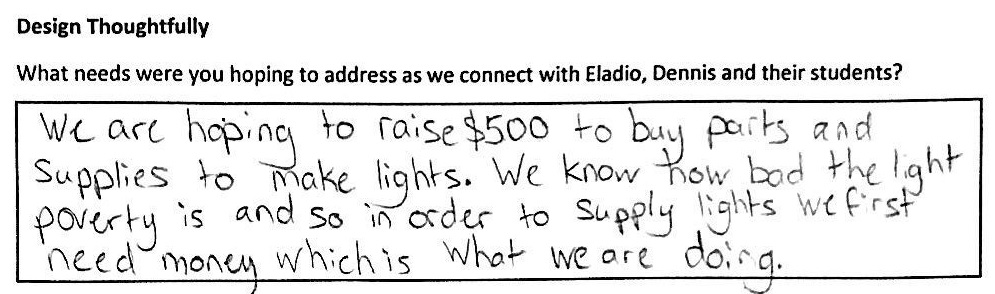
Seconds after our Skype chat was over with Eladio, Dennis and the students from the Dominican Republic, we were talking needs. Now the needs might be a little more obvious when we are talking about the people living as sugar cane workers in the Dominican Republic.  There might be one or two hours of electricity a day.  There might be none.  And if electricity is available, it is during the day.  Light at night is a real issue and affects both learning and safety.  It was hard to hear about people dying in fires as a result of candle and kerosene lamp use at night from Dennis during our Dominican Republic Skype chat.

But empathizing needs looked vastly different for the SSEP CBL my students did.  In that case, our experiments would never get on the Space X rocket if they didn't address a need.  The need gives meaning to the action.  It gives meaning to the making.  The need has to be there. Without it, why bother.

My students went through a whole CBL process as they designed their Engineering Brightness learning experience. The first thing was to reflect on the connection, ponder the needs they discovered, and develop the learning goals they have for themselves.  Here are some student samples:


With students discovering needs through the connection, the next step is to Co-construct Learning Goals.  I will continue to share as this CBL develops.  Look for the next post: Co-construct Learning Goals | #CBL Collaboration Lens.

Consider partnering with us as we fight light poverty in the Dominican Republic.